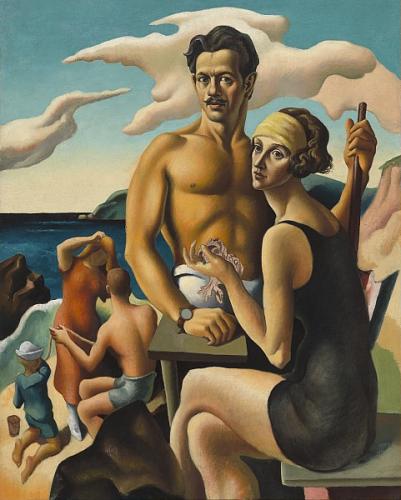
He never liked being referred to as an American Regionalist.
Yes, he was tied to Western Missouri from birth to the day he died, born into a prominent family with deep roots in the state. And yes, the themes he returned to repeatedly were simple rural scenes and depictions of the everyday lives of working-class people in America.
But Thomas Hart Benton (1889-1975) was his own man and he rejected being labelled.
American Regionalism is an modern art movement that portrayed scenes of rural and small-town America, primarily in the Midwest. It arose in the 1930s as a response to the Great Depression. The movement is best known through the “Regionalist Triumvirate,” the three highly respected artists of America’s Great Depression era: Grant Wood, Thomas Hart Benton, and John Steuart Curry. All three studied art in Paris, but devoted their lives to creating a truly American form of art.
Thomas Hart Benton was the third generation in a political clan, and it was somewhat expected that he would follow the family tradition. But he was drawn to the arts, music and painting, and his mother encouraged those interests. So, Tom went his own way — despite his father being a US congressman, and his great-uncle (for whom he was named) Missouri’s first US senator, who served as a primary architect of the early platform of the Democratic party.
Benton studied at the Art Institute School in Chicago and at the Académie Julian in Paris, learning modernist art theory, rejecting traditional themes and styles of painting. In Paris he was part of the expatriate avant-garde, dabbling in Fauvism and Cubism. He delved into Synchromism, using pure, vibrant colors to create abstract forms and spatial harmony, in much the same way as a composer arranges notes in a symphony. As an accomplished musician, connecting musical concepts to painting struck a chord with him — pardon the pun.
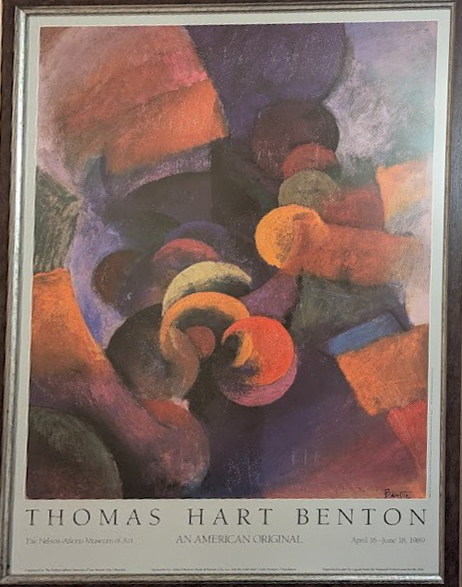
Example of a Benton Synchromist work 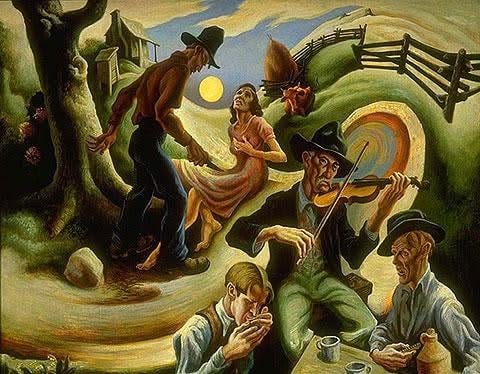
Ballad of the Jealous Lover of Lone Green Valley, 1934.
Synchromism — color as music — was developed in Paris around 1912–1913 by American modernist painters Morgan Russell and Stanton Macdonald-Wright. Synchromists believed color scales and chords could trigger emotional and sensory responses, similar to hearing music. It was the first avant-garde abstract art movement conceived and driven primarily by American artists.
After Paris, Benton settled in New York City in 1912. Now a thoroughly modern painter, he taught aspiring young artists and mixed with other cutting edge artists and leftist intellectuals.
When World War I interrupted life in 1918, he enlisted and was stationed at the Norfolk VA naval base. He was tasked with painting ships entering the harbor to document their camouflage schemes, and documenting the shipyards and the work being done there. The Navy needed accurate representations of real things: ships, machinery, men at work.
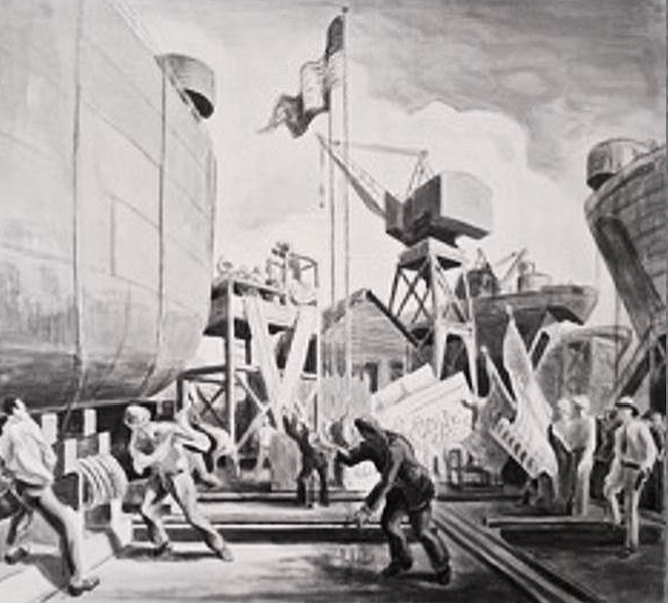
Norfolk Navy Yard 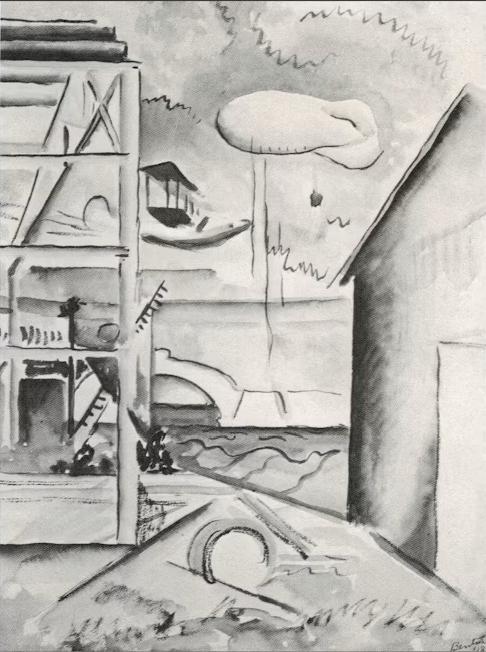
Blimp at the Navy Yard 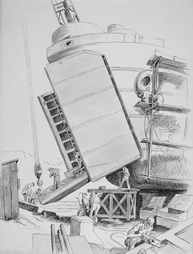
The Ship Gets its Mouth
This experience changed his art.
Over the course of the 1920s, he turned away from abstraction toward representational figural painting. The daily exposure and interaction with ordinary hard-laboring people in Norfolk had resonated with his deeply ingrained beliefs … steeped as he had been, growing up, in his family’s political republicanism and populism. Benton later said that his work for the Navy “was the most important thing, so far, I had ever done for myself as an artist.”
He didn’t just suddenly and quietly move on. Saying he had “to get all that modernist dirt out of my system,” he loudly, somewhat belligerently, rejected contemporary abstract artistic trends and began to develop a personal style that drew on his previous travels in Europe, where he had absorbed Michelangelo’s Sistine Chapel frescoes and the late-Mannerist figures of El Greco. Those influences can be seen in the exaggerated curvilinear and muscular forms and the bold use of color in the two paintings shown here.
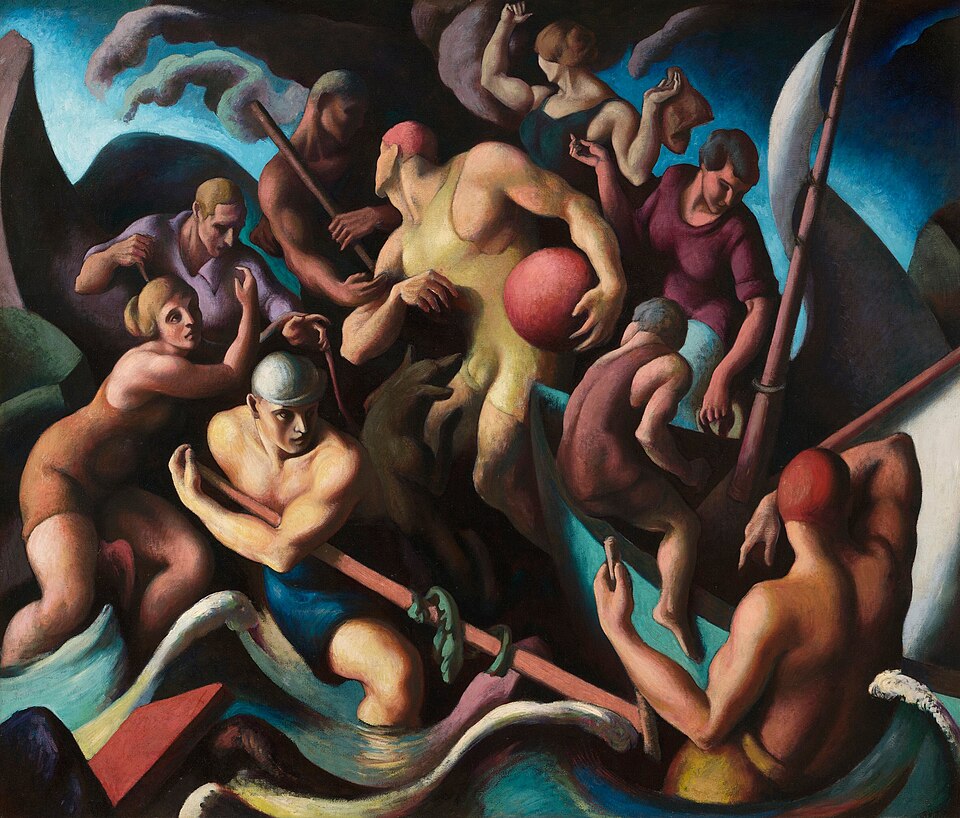
People of Chilmark, Thomas Hart Benton, 1920. Hirshhorn Museum, Washington, D.C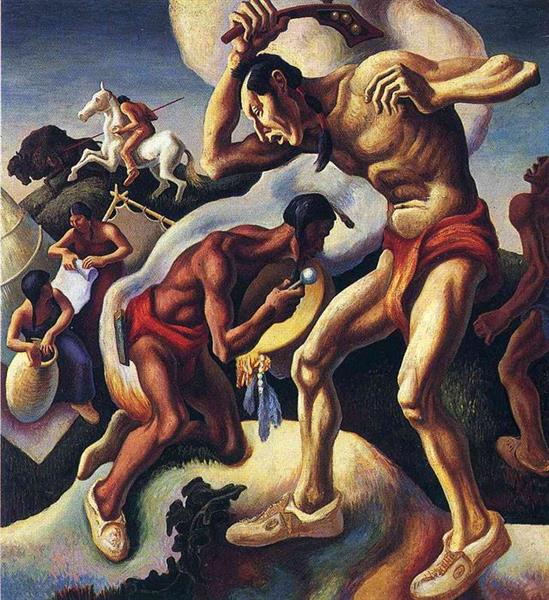
Indian Arts, Thomas Hart Benton, 1932.
New Britain Museum of American Art, New Britain, CT, US
Jackson Pollock was one of Benton’s students at the Art Students League of New York, from 1930-1933. If you only know Pollock for his “drip paintings” you might be surprised to learn that he was a disciple of Benton’s regionalism during the years of the Great Depression. He and Benton became close life-long friends. Pollock stayed with the family during summers at their Martha’s Vineyard home, he babysat the Benton children, and became Godfather to their daughter. His likeness can be seen in some of Benton’s works; he’s the harmonica player in the Ballad of the Jealous Lover of Lone Green Valley shown above.
Ironically, while Benton was turning away from abstraction — developing his new dynamic figural compositional theory, using reciprocating rhythms, twisting movements, and geometric grids to organize a canvas — he was inspiring the reinvention of abstract painting itself. “His preoccupation with surge and flow got across to Pollock and led to Pollock’s invention of ‘all-over’ abstraction” with his drip paintings. (Quote from a 1989 Time Magazine review of an exhibition of Benton’s work at the Nelson-Atkins Museum of Art in Kansas City.)
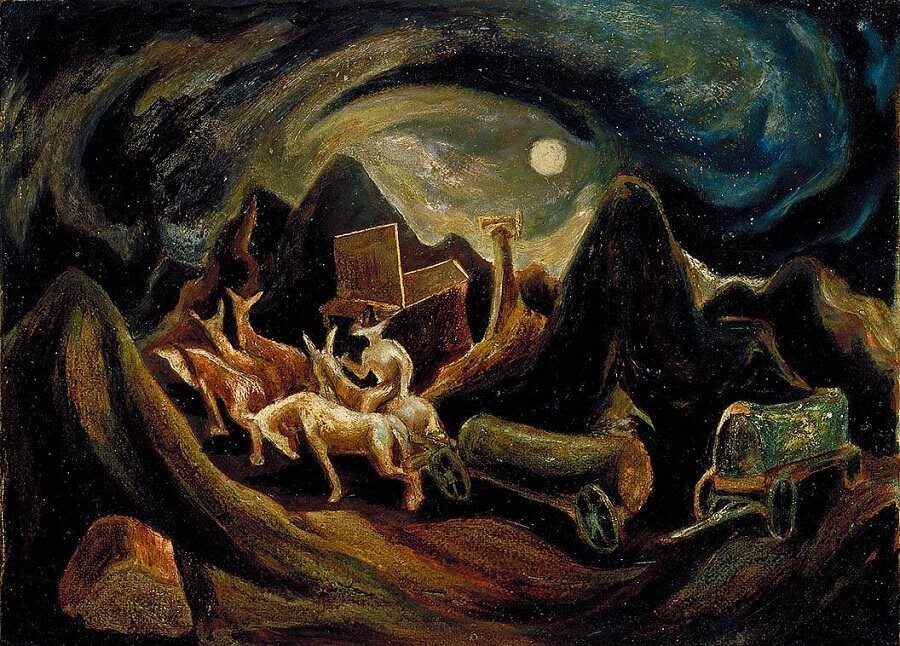
Going West, Jackson Pollock, 1935. Smithsonian American Art Museum, Washington DC 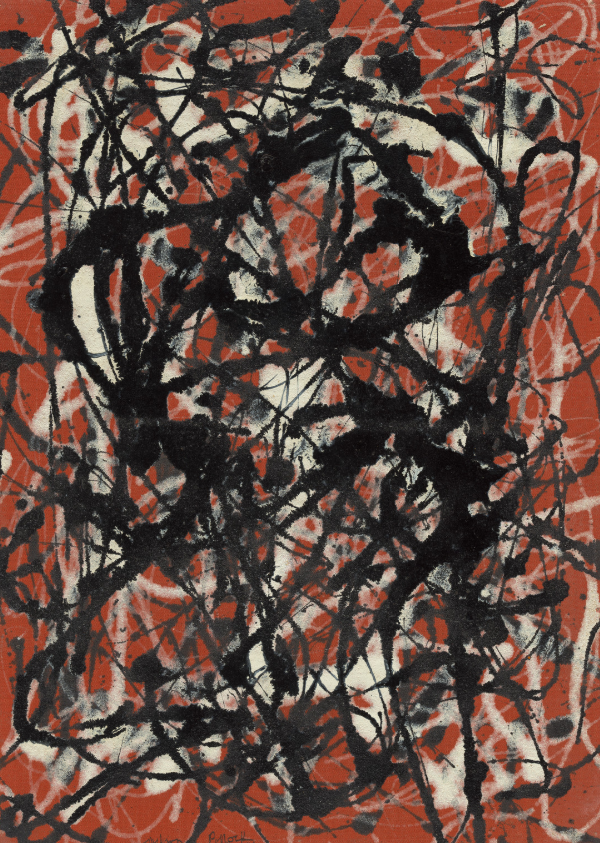
Free Form, Jackson Pollock, 1946. Museum of Modern Art, NYC NY (considered to be his first drip painting)
Even when Pollock’s style changed dramatically in the late 1930s and 1940s, he always acknowledged that his teacher’s strong rhythmic principles were the bedrock of his art.
We recently took off for a fortnight on an art pilgrimage in Missouri. Two of our primary goals were the Nelson-Atkins Museum of Art and the Thomas Hart Benton House and Studio in Kansas City. We quickly realized that, along with Harry S. Truman and Samuel Clemens, Benton is a favorite son in that state.
The Nelson-Atkins Museum holds the most extensive public collection of Thomas Hart Benton works in the world (almost 150 works), of which 45 paintings and drawings were bequeathed by the artist. While only a select handful of these artworks are typically on view at any given time, the museum frequently draws from this cache for special exhibitions.
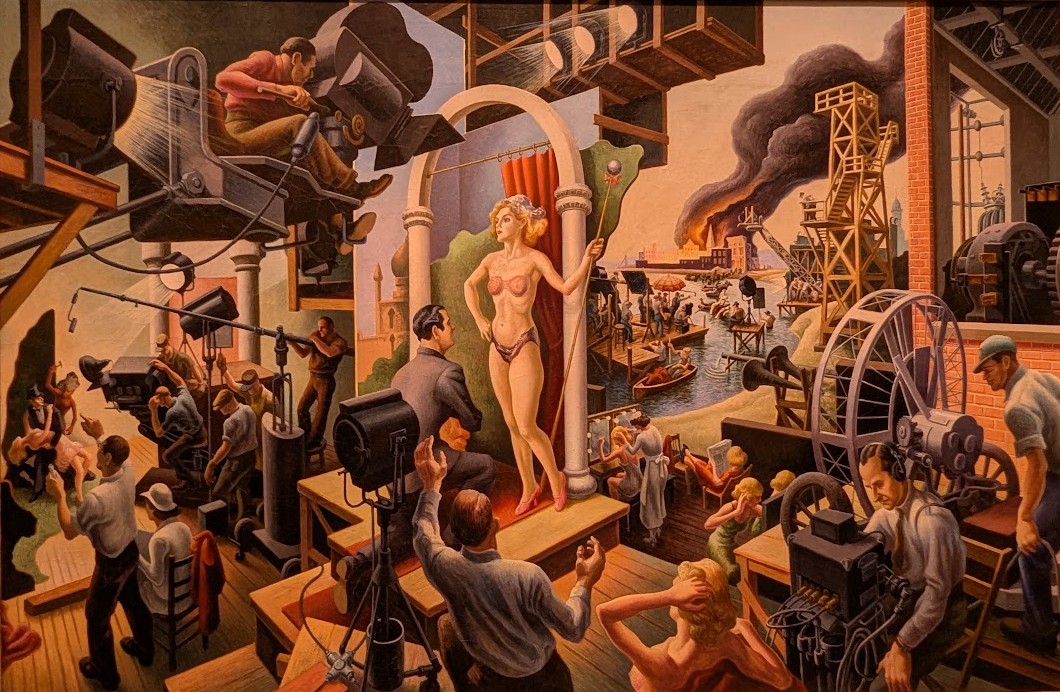
Hollywood (1937-38) 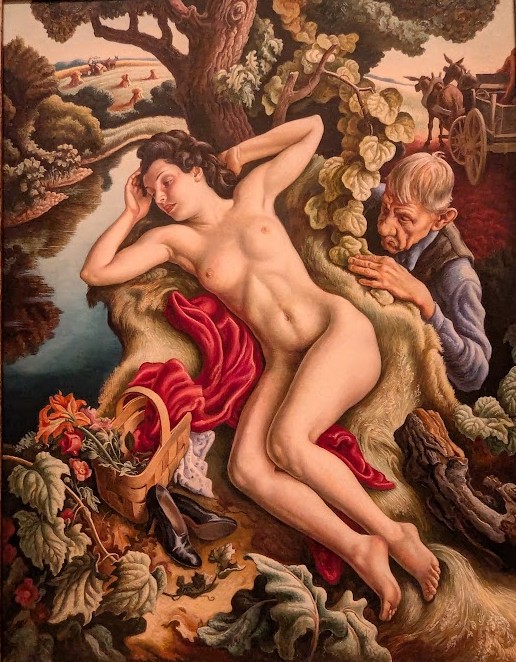
Persephone (1938-39) 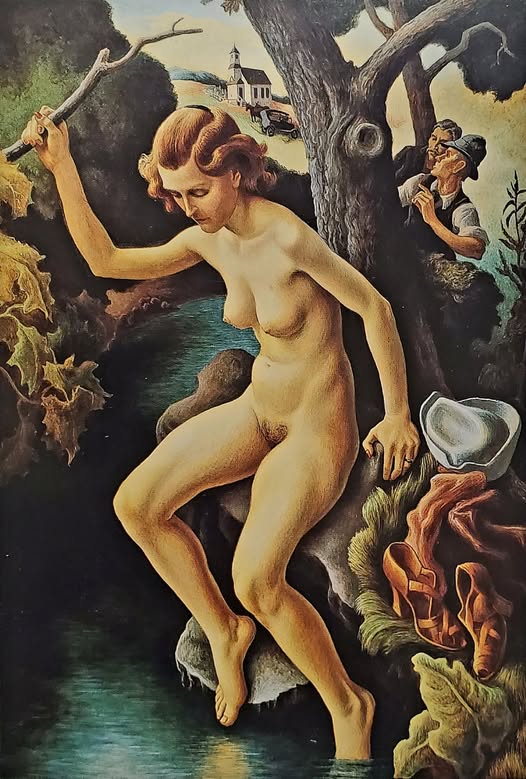
Susanna and the Elders (1938) Fine Arts Museums of San Francisco, CA 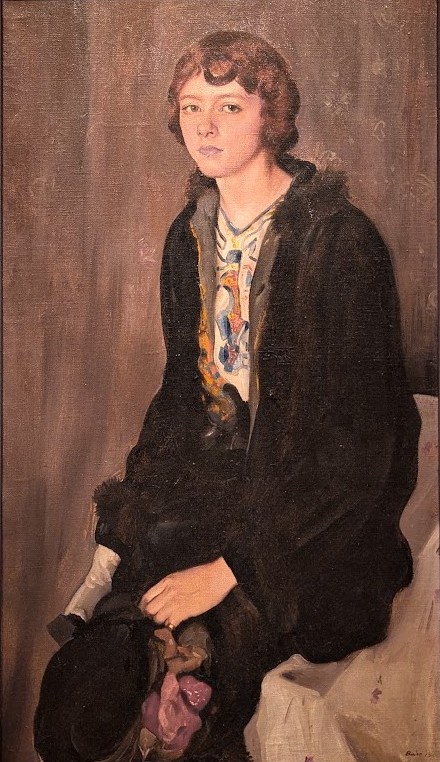
Portrait of the Artist’s Sister Mildred (1913) 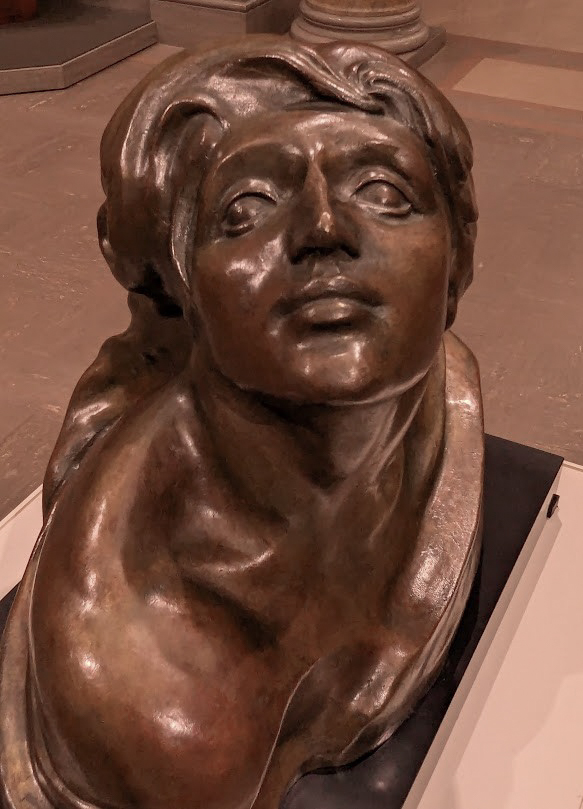
Rita (modeled 1918, cast 1961) 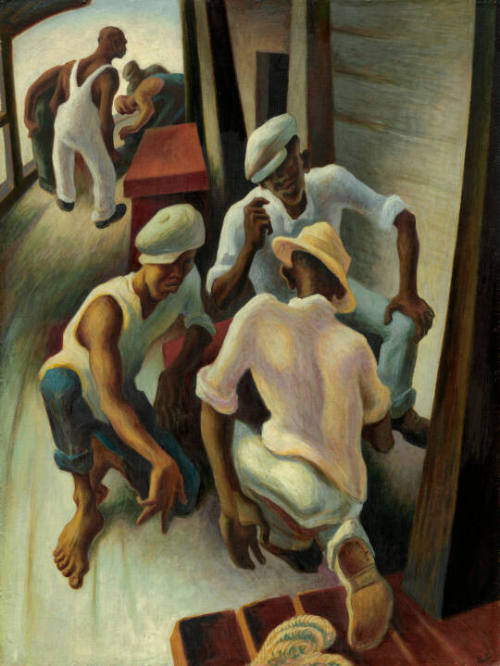
Crapshooters (ca.1928)
Benton was 24 when he painted the Portrait of The Artist’s Sister Mildred, shown above, when he was studying art in NYC. It was used as an illustration for an article in Collier’s Magazine, and earned him his first widespread publicity. On the other hand, Hollywood, shown above, was rejected by Life Magazine as too risqué to publish in a family magazine. Nonetheless, the painting did appear in that magazine after it won a prize in a major juried exhibition in 1938!
Persephone, shown above, depicts a healthy farm girl in the role of the Greek goddess resting nude beside a stream in a rural Midwestern landscape, enjoying her temporary release from the underworld. An aging, libidinous farmer, standing in for Pluto, ogles her from behind a tree. His chariot stands in the background, harnessed to a couple of mules. One wonders whether Benton was more inspired by Old Master female nudes or contemporary cheesecake pin-ups! (Compare it to his more restrained Susanna and the Elders, shown above — which we did not see — that was painted during the same period.)
The stunning bronze portrait of Benton’s wife, Rita, shown above, demonstrates his versatility as an artist. He created the original plaster of Paris sculpture in 1918, when Rita was 17 and still his student, and it is his earliest known three-dimensional work. He and Rita Piacenza wed in 1922, and they were married for almost 53 years.
Crapshooters, shown above, was painted in 1928. Benton frequently portrayed black people in his works, considering them an inherent thread in the fabric of American culture. He was criticized for it, of course, but he refused to misrepresent the facts of everyday life. These three stevedores that he saw shooting dice on the deck of a Mississippi riverboat were, to him, as important a part of the American chronicle as anyone else
More than a decade after returning to NYC following his stint in the Navy — all the while increasingly disillusioned by the art scene there — Tom moved back to Kansas City with his young wife. During those interim years he had taken many trips around the country to capture the daily life of Americans, staying in backwoods hotels and at the homes of the local people. He sketched farmers working in their fields, church meetings, boys swimming, children in schoolhouses, and life around the town square. He was drawn back to his mid-western roots.
They bought a two-story house built of native limestone in the very desirable Roanoke neighborhood. (The year they move in, a Frank Lloyd Wright Usonian home was being built on the lot next door.) Benton converted half the carriage house into his art studio, and Tom and Rita lived on this property for almost 40 years until his death in 1975. Rita died just eleven weeks later.
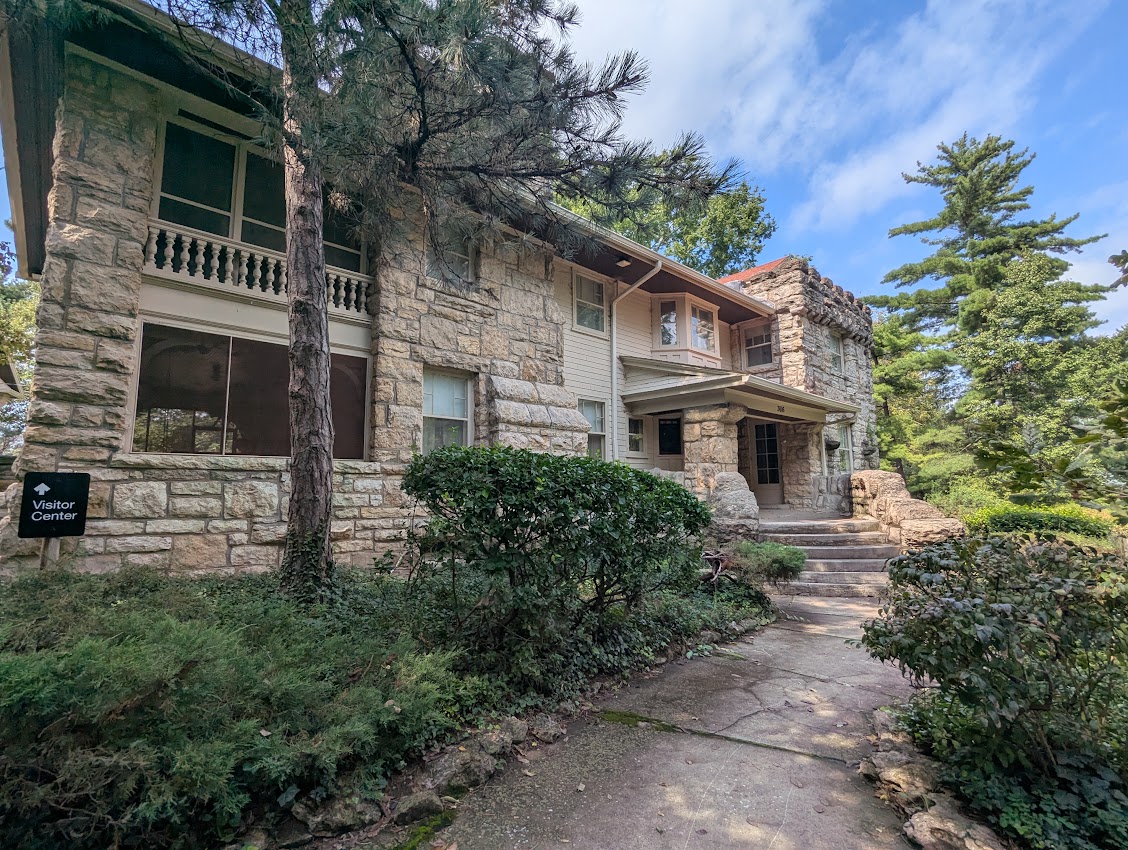
Exterior view of Tom and Rita’s home 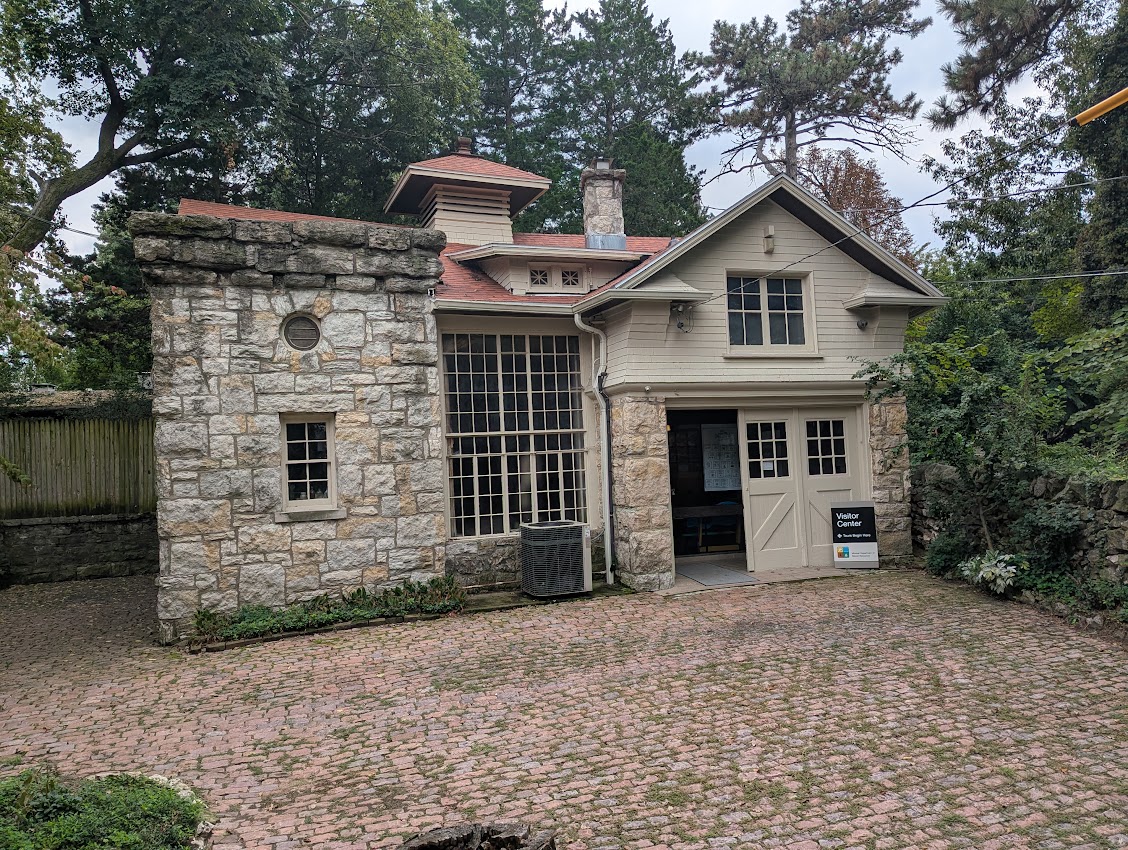
Exterior view of Benton’s studio, 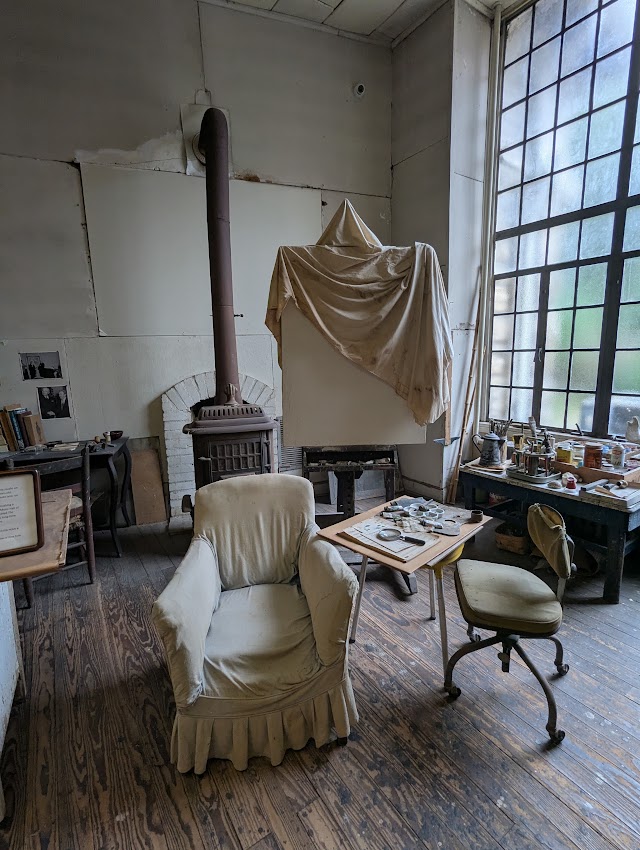
Interior view of Benton’s studio 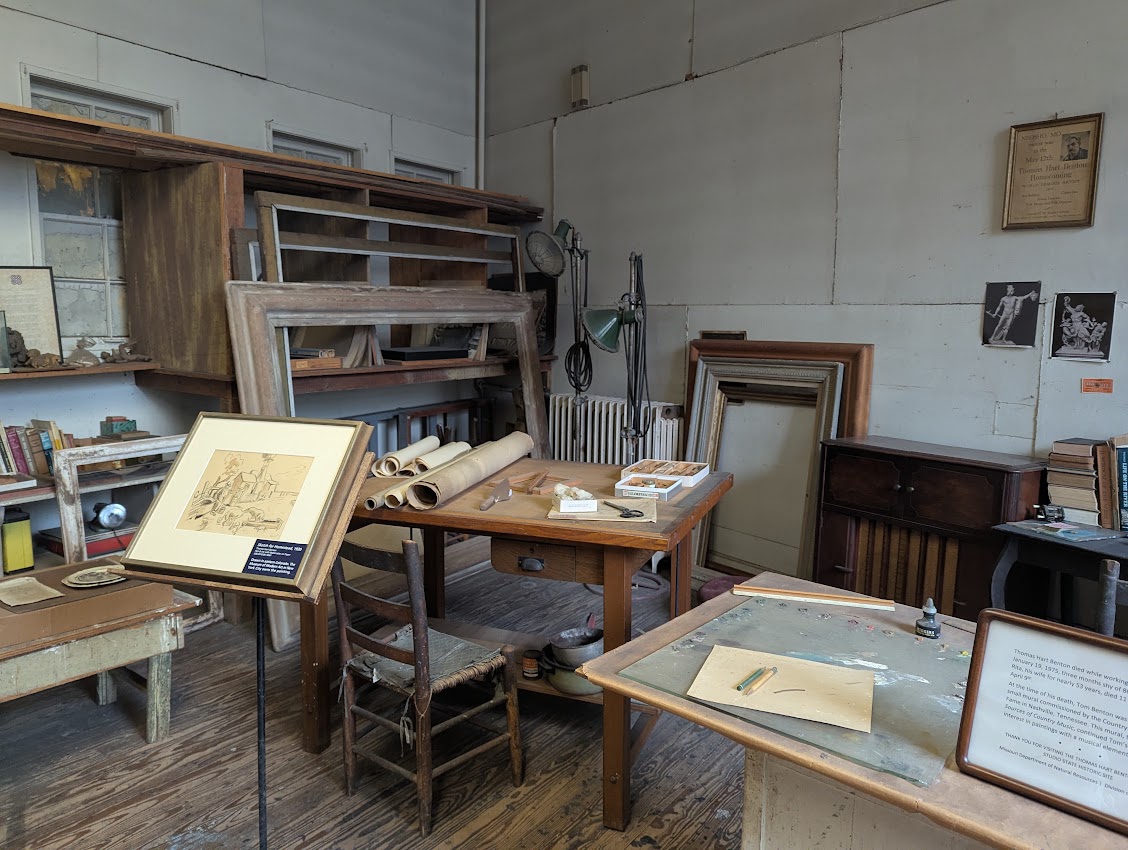
Interior view of Benton’s studio 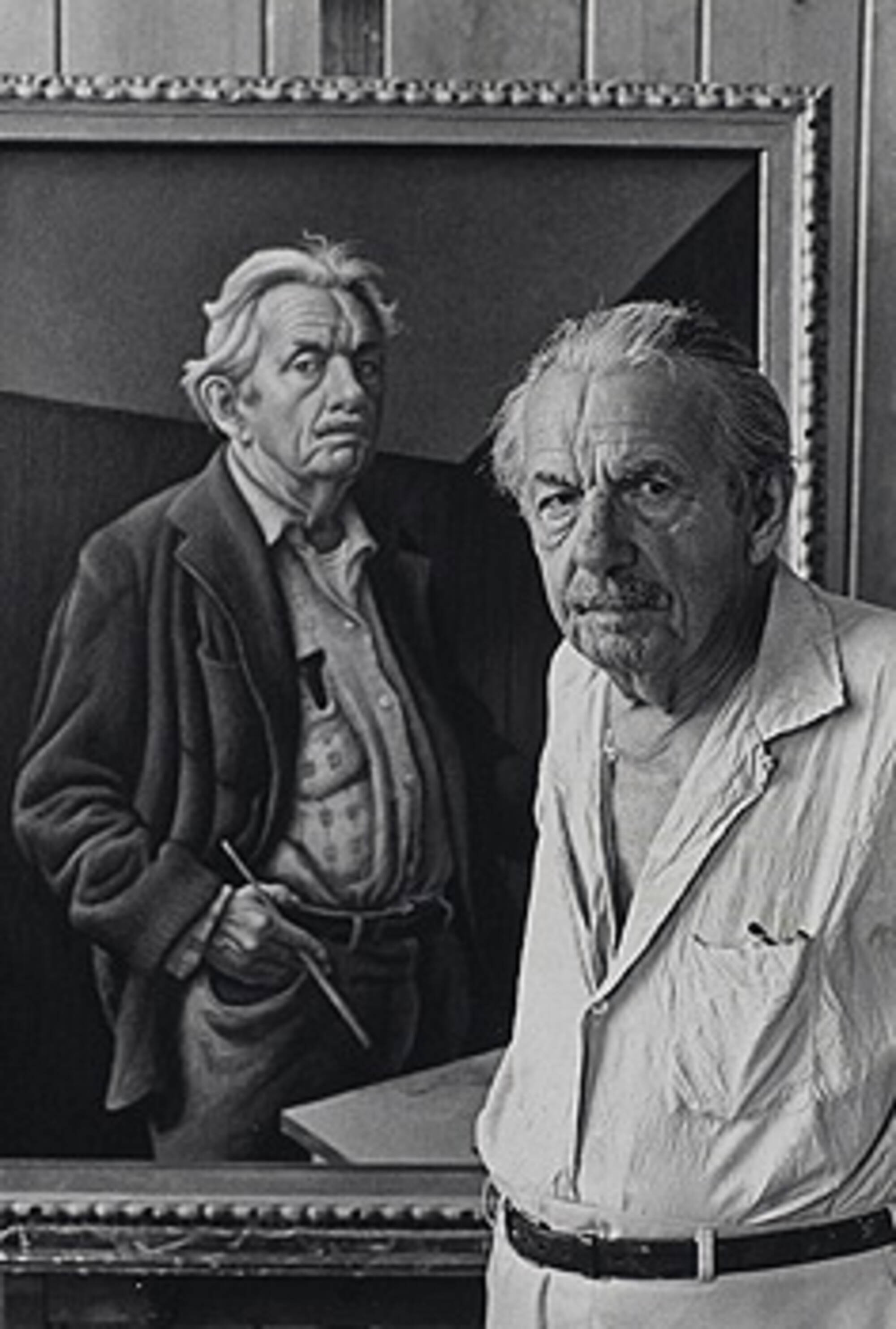
Benton with his 1972 self-portrait 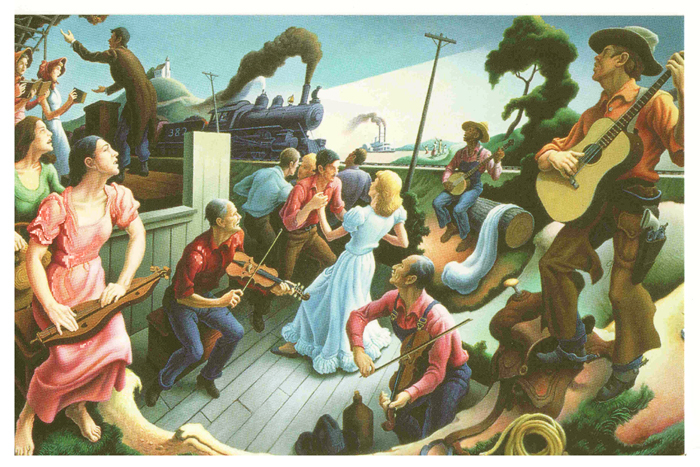
His last work, The Sources of Country Music (1975)
Three months shy of 86, Tom Benton collapsed and died late one night in his studio, as he was putting the finishing touches on his six-foot by ten-foot mural for the Country Music Hall of Fame in Nashville, The Sources of Country Music. Rita’s passing so soon after her husband meant that the contents of the house and his studio were left virtually intact, giving posterity an authentic view into how he lived and worked. In the studio, his paints, coffee cans full of paintbrushes, and a stretched canvas on an easel seem to await the start of his next project.
The garage adjacent to the studio is now the Visitors’ Center, with a small museum of photographs and memorabilia. Thomas Hart Benton was an easel painter, a muralist, a sculptor, an illustrator and a teacher. He illustrated 13 books. His work featured in the promotional material for Darryl Zanuck’s Grapes of Wrath, directed by John Ford and starring Henry Fonda.
His image graced the cover of Time Magazine in 1934. Although many art critics disdained his narrative style, during the decade of the Great Depression he was one of the most famous artists in America, especially among the everyday people he celebrated in his work.
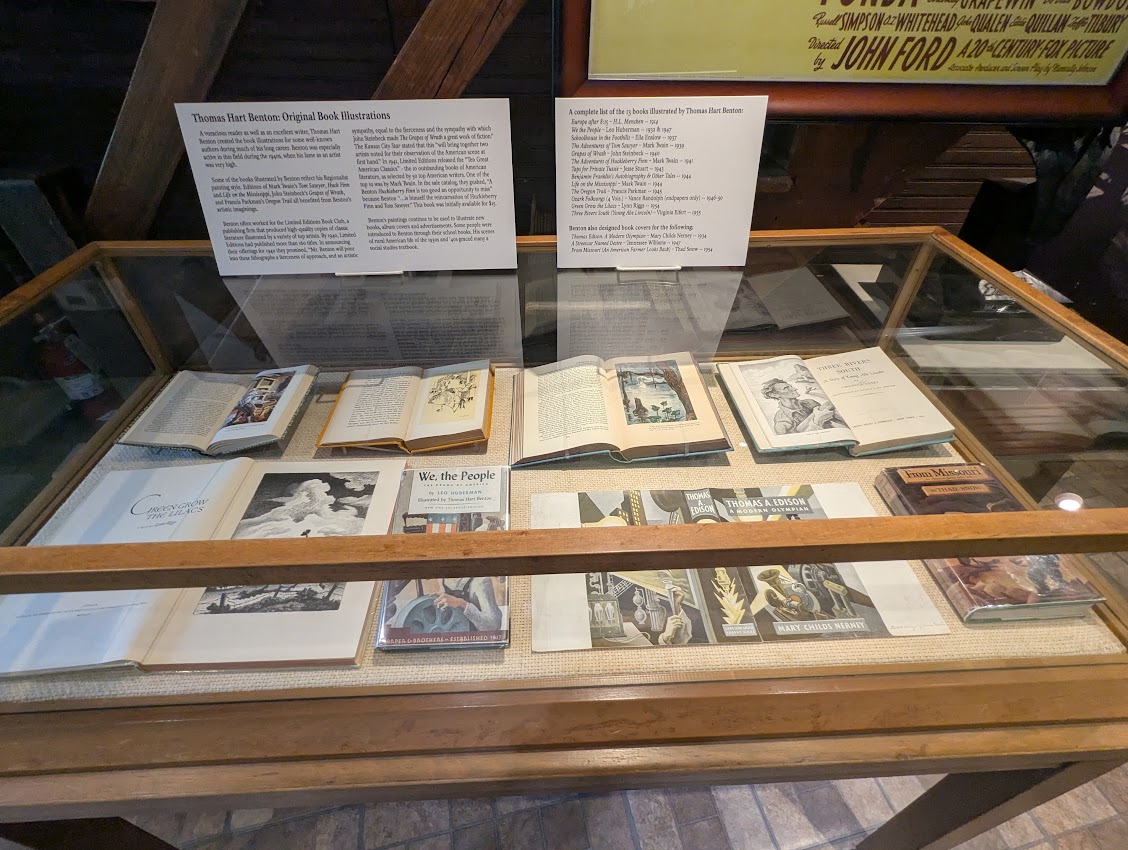
Display of books illustrated by Benton 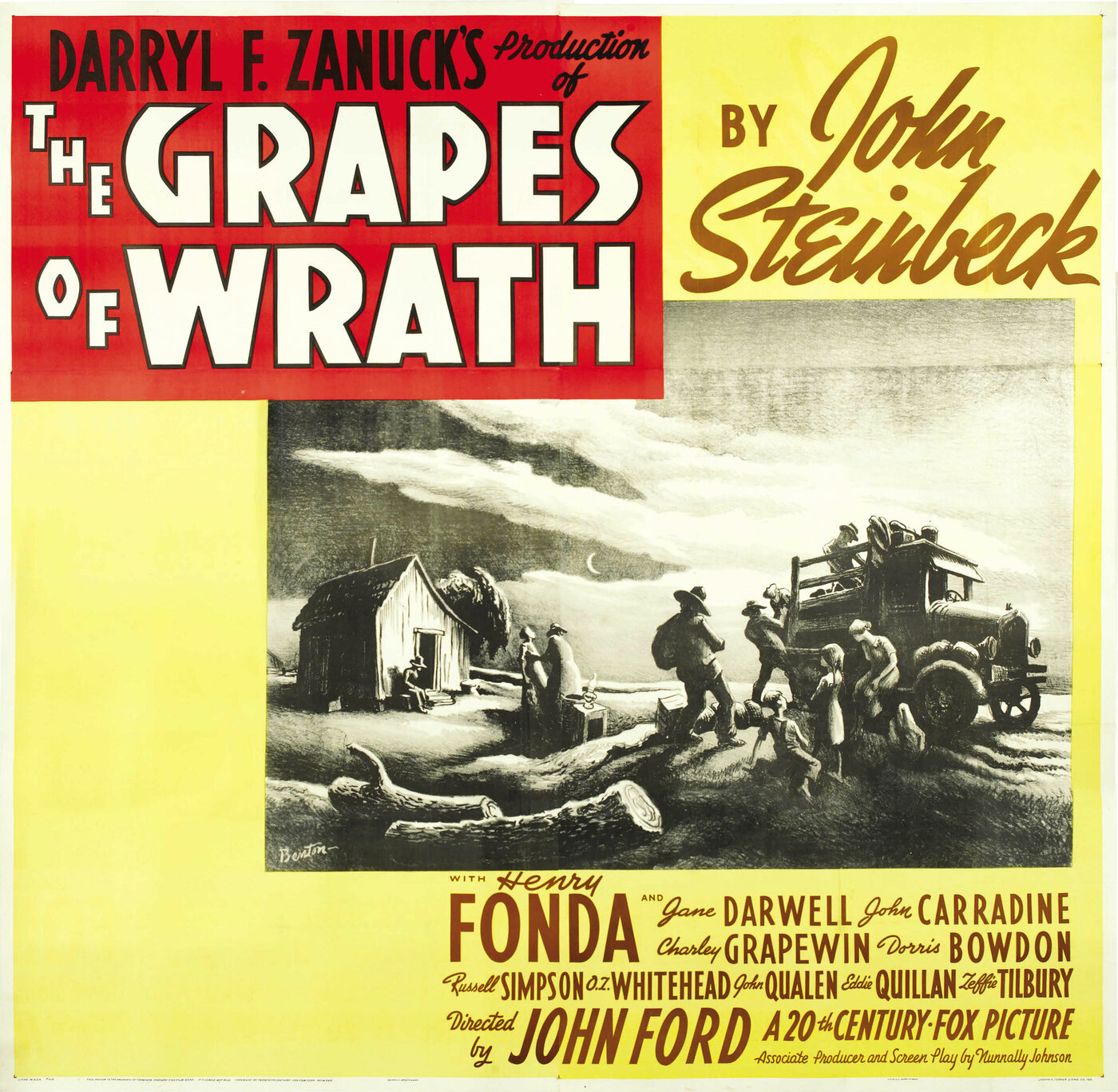
Movie promotion illustrated by Benton 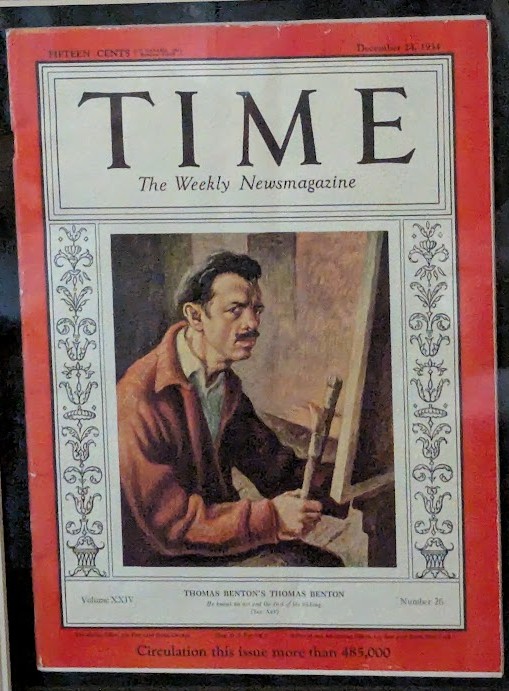
The first artist ever to appear on the cover of Time, December, 1934
The interior of the rambling family home underscores the Benton’s lack of pretension. Our guide brimmed with vivid anecdotes and pointed out easily-missed details throughout the home, so that we came away with a strong sense of understanding of Tom Benton as an artist, a husband, a father and a friend.
While most of the original artwork in the house has been replaced with reproductions — the originals preserved in museums — the furnishings are exactly as they were left. And the bar. And Rita’s closet. …
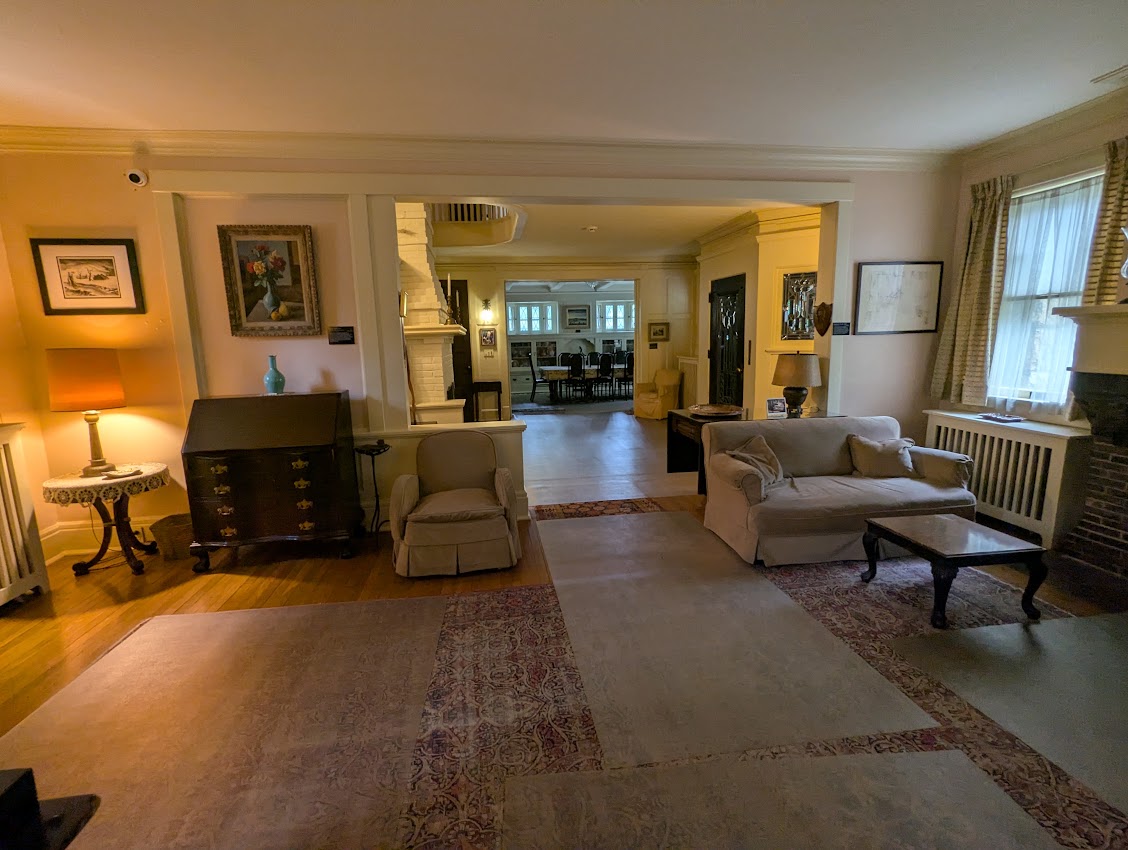
View of living room, entry & dining room 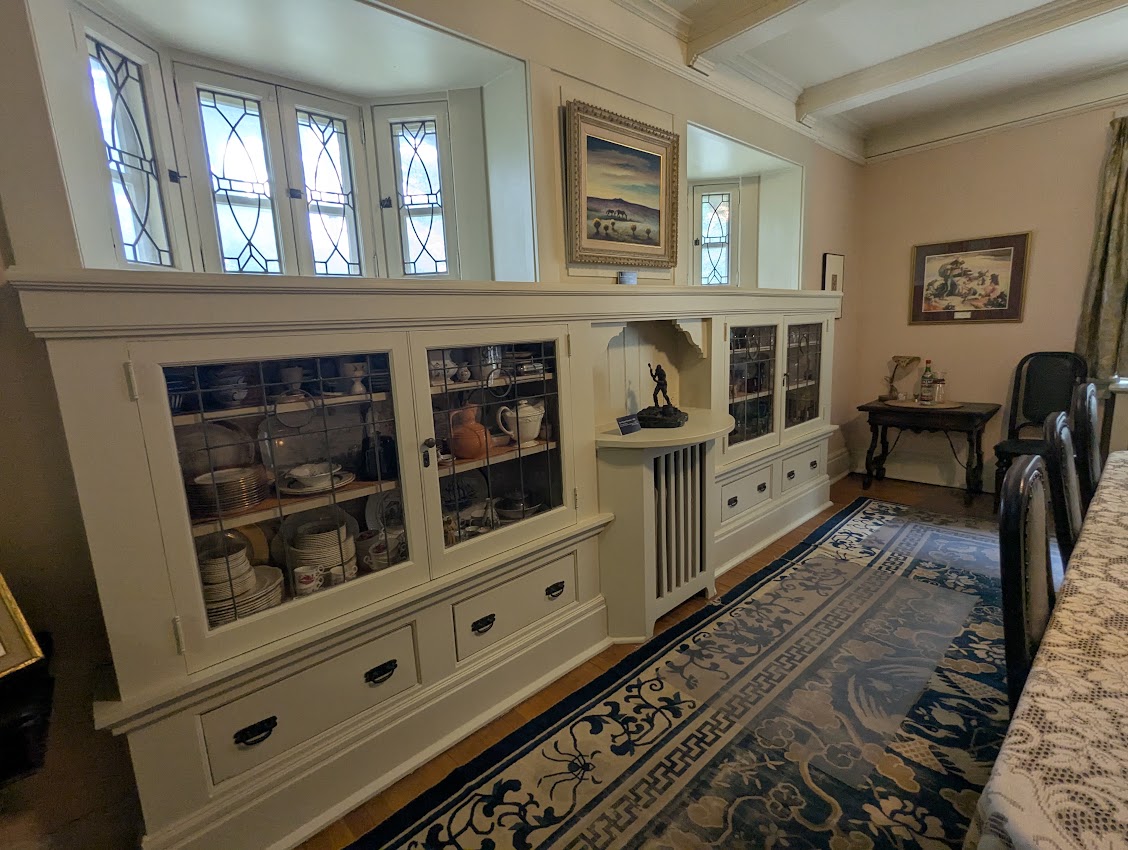
The dining room 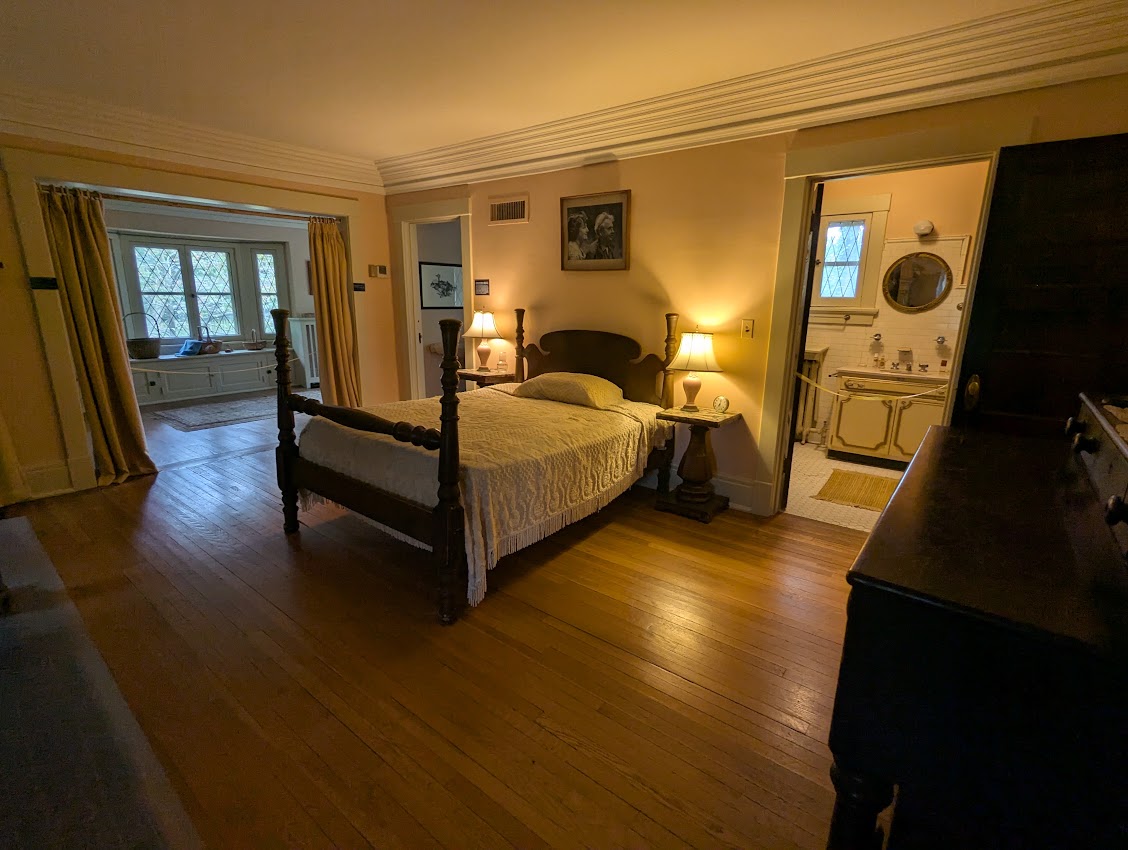
Rita’s bedroom 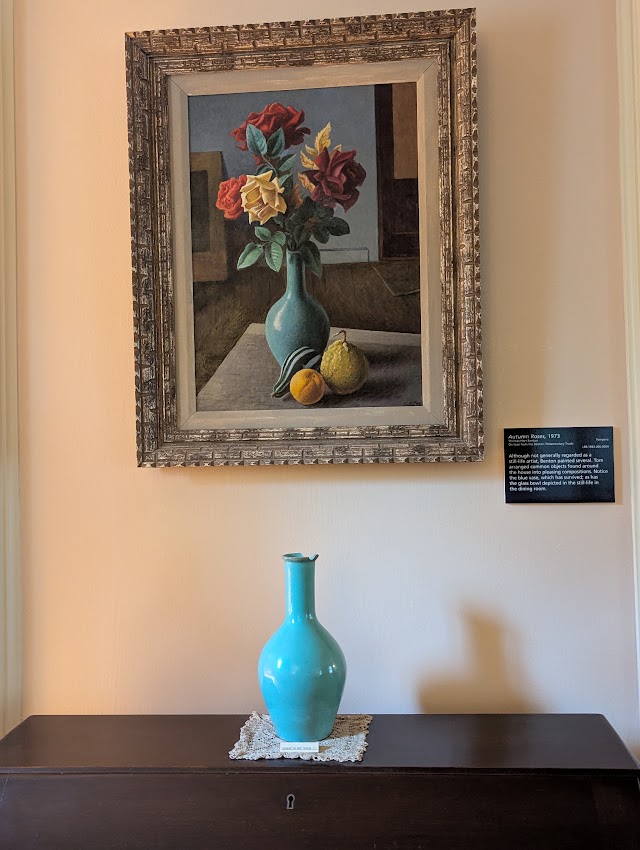
Autumn Roses, THB (1973) and the vase 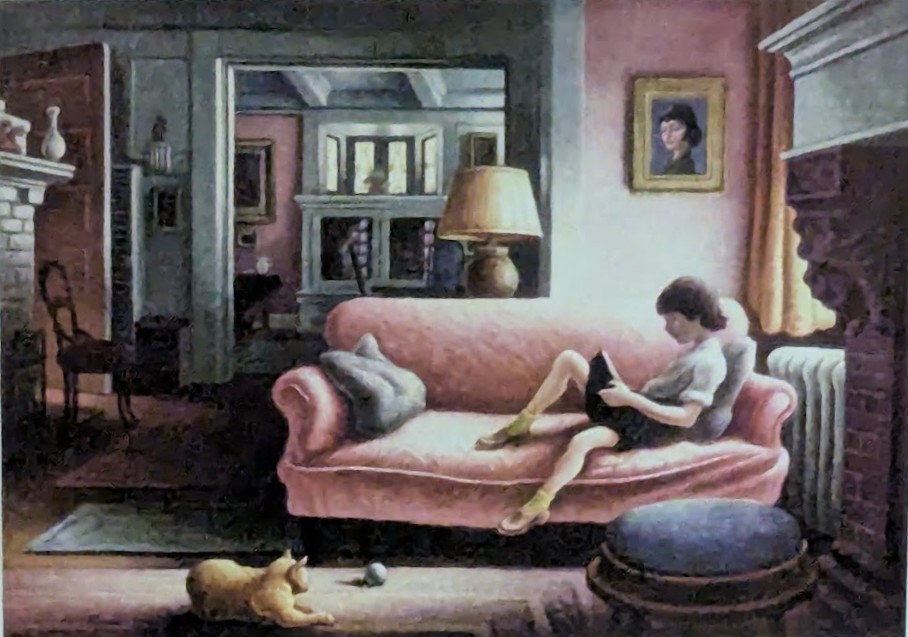
Interior, THB (1948) Daughter Jessie reads on the sofa with the dining room behind 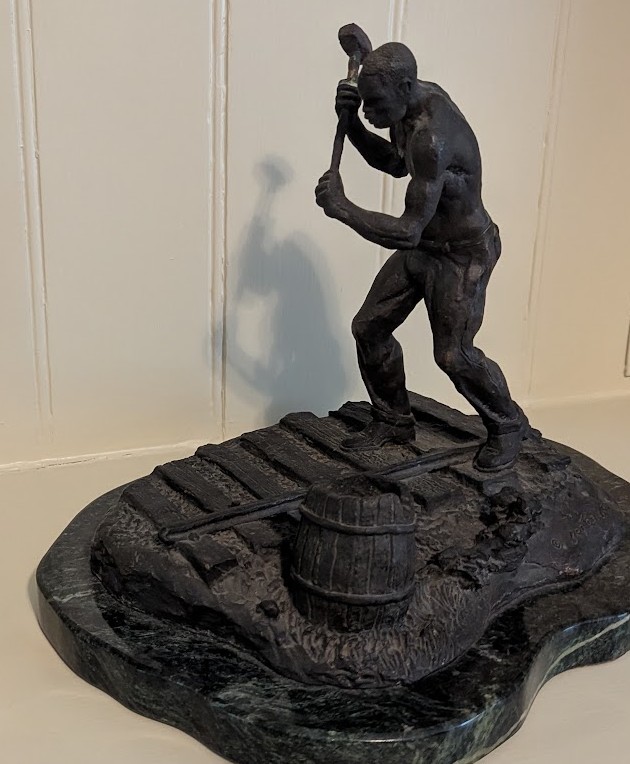
Ten-Pound Hammer, THB (1965), bronze 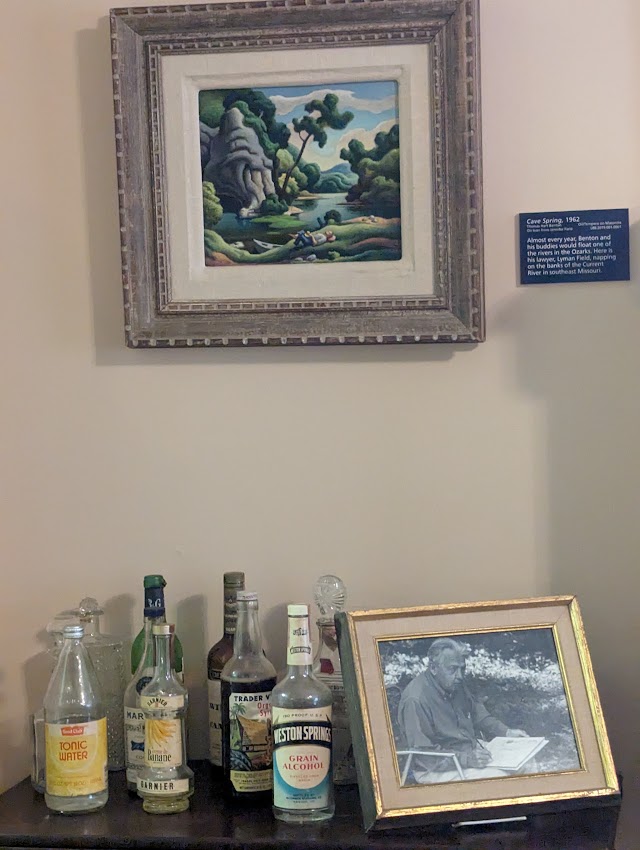
The bar, as it was left 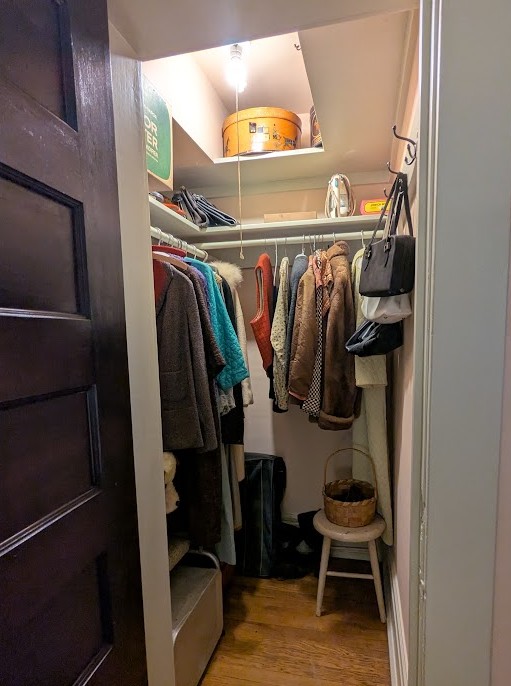
Rita’s closet, as it was left 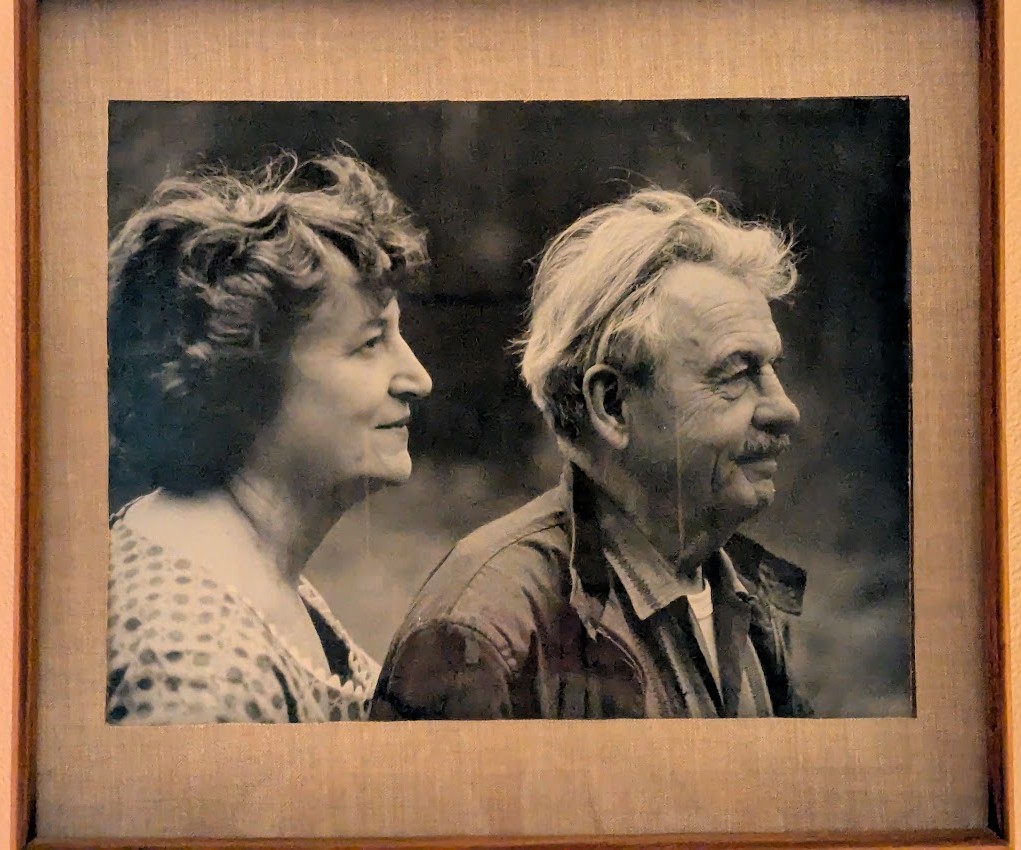
Rita and Tom, married 53 years
As an accomplished painter of narrative epics of American history and folkways, Benton was a sought-after muralist. He loved the magnitude of mural painting, writing in his book, An Artist in America: “The very thought of the large spaces puts me in an exalted state of mind, strings up my energies, and heightens the color of the world. […] When the mural is finished, I have a great letdown.”
He created four expansive murals during the 1930s, of which the massive 250-foot-long, 26-panel, A Social History of the State of Indiana (1933), commissioned for the Chicago World’s Fair gave him the widest exposure. The mural famously included a depiction of the Ku Klux Klan that created a furor but, as usual, Benton did not surrender to the controversy. He was adamant about representing the darker chapters of history that should not be glossed over or hidden. He argued that the KKK’s massive political power in Indiana during the 1920s was a reality that society needed to confront.
Click here to read our article about Thomas Hart Benton’s murals.
Once he had moved away from the modernist track he started out on, having returned to his populist mid-western roots, Benton’s style remained little changed from the 1930s through his death in 1975. He established himself outside the progressive art world with an anti-elitist, warts-and-all narrative vision of American life.
Thomas Hart Benton was his own man.
Hmmm … maybe it’s time to plan a little trip …
Nelson-Atkins Museum of Art
4525 Oak Street, Kansas City, MO
816-751-1278
Thomas Hart Benton Home & Studio State Historic Site
3616 Belleview, Kansas City, MO 64111
816-931-5722
Header image: Self-Portrait with Rita, 1924. National Portrait Gallery, Washington DC
Art Things Considered is an art and travel blog for art geeks, brought to you by ArtGeek.art — the only search engine that makes it easy to discover 1800 art museums, historic houses & artist studios, and sculpture & botanical gardens across the US.
Just go to ArtGeek.art and enter the name of a city or state to see a comprehensive interactive listing of museums in the area. All in one place: descriptions, locations and links.
Use ArtGeek to plan trips and to discover hidden gem museums wherever you are or wherever you go in the US. It’s free, and it’s easy and fun to use!
© Arts Advantage Publishing, 2026