
He said, “I’ll paint you a picture if you’ll finance the eggs.” They did, and he did. It was 1930, it was his first mural, and it made him famous. It wasn’t long before he was on the cover of Time Magazine, the first artist ever featured there.
Thomas Hart Benton became America’s #1 muralist, a painter of narrative epics of American history and folkways. He completed four vast mural cycles in the decade of the 1930s. He loved the sheer magnitude of mural painting.
“The very thought of the large spaces puts me in an exalted state of mind, strings up my energies, and heightens the color of the world. […] A certain kind of thoughtless freedom comes over me. […] The sweep of my brushes, after I really get started, becomes precise and somehow or other beyond error. I get cocksure of mind and temperamentally youthful. I run easily into childish egomania or adolescent emotionalism. When the mural is finished, I have a great letdown.”
That first expansive mural, completed in 1931, was a ten-panel cycle he titled America Today, commissioned for the third-floor boardroom of the New School for Social Research in New York City. He received no payment beyond the cost of materials —including the large quantity of eggs he needed to mix yolks with dry pigments to make his signature egg tempera paint.
Benton, who was approaching middle age and still struggling for recognition, cannily accepted the unpaid terms as a way to build his reputation, showcasing his skill in a very public way to secure future paid commissions. It was a wise move. America Today established him as the era’s leading American muralist, and the enthusiastic reception of the extended narrative was a driving force behind the Works Progress Administration (WPA) mural program of the Great Depression.
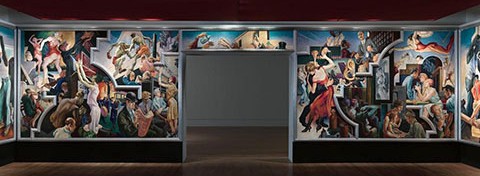
In America Today, Benton celebrated and confronted the candid truths of American life. In the words of Vicky Oliver, writing in the New School’s LIT Magazine, “It was a story of progress, as illustrated by trains racing across the country, ships cruising the waterways, subways transporting people to their offices, factories manufacturing goods, and airplanes flying celestial blue skies. A story of forward motion, of resilience, of a can-do-American work ethic.”
The largest America Today panel, Instruments of Power, is filled with the mighty machines of modern American industry. Painted when the country was in the throes of the Depression, Benton’s scenes nonetheless promote the idea of “progress” built on modern technology. And that progress, to Benton’s way of thinking, was built on human labor. Powerful, heroic workers animate the mural, many of them Benton’s friends, including Jackson Pollock, who modelled for him.
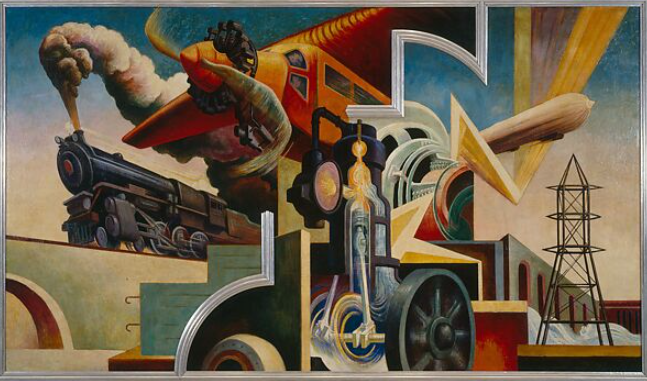
Instruments of Power 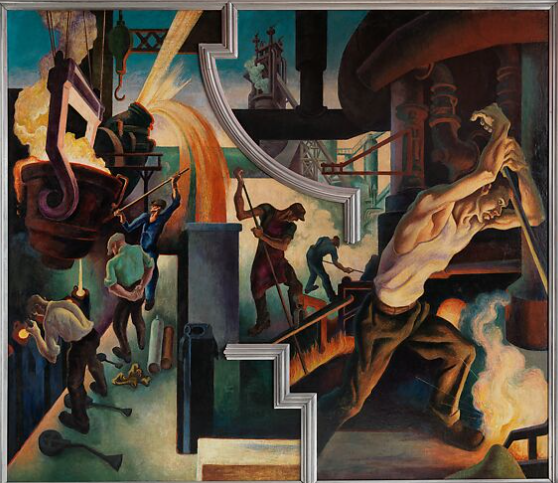
Steel 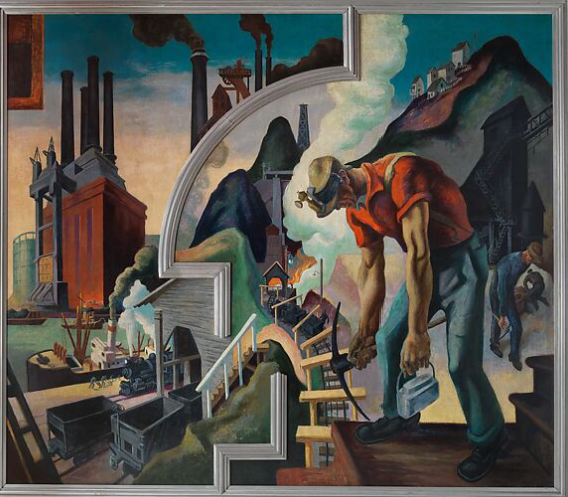
Coal
Eight of the America Today panels depict life in different regions of the United States: the South, the Midwest, the West, and New York. Benton had traveled widely in the 1920s, creating studies from life, of American life, on which he based many of the details in America Today.
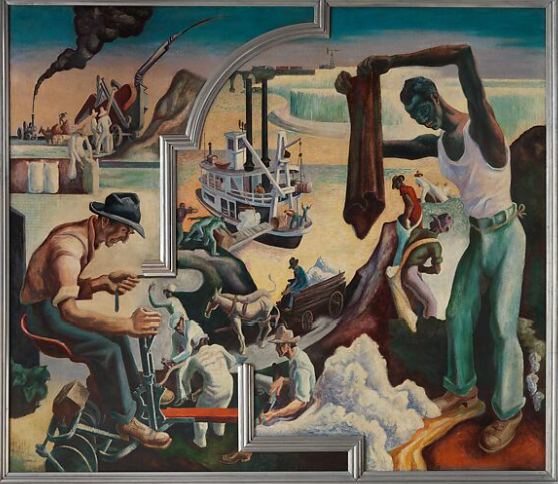
Deep South 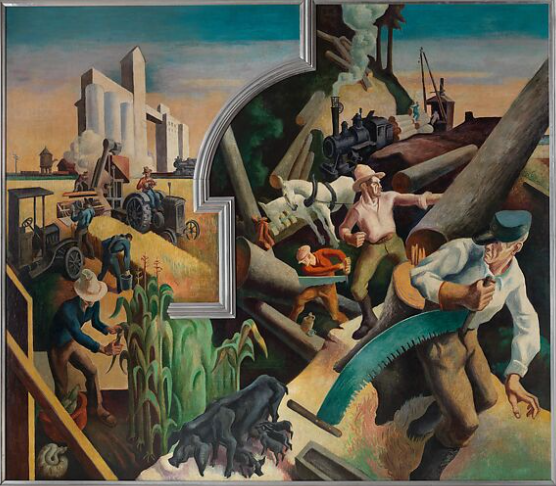
MidWest 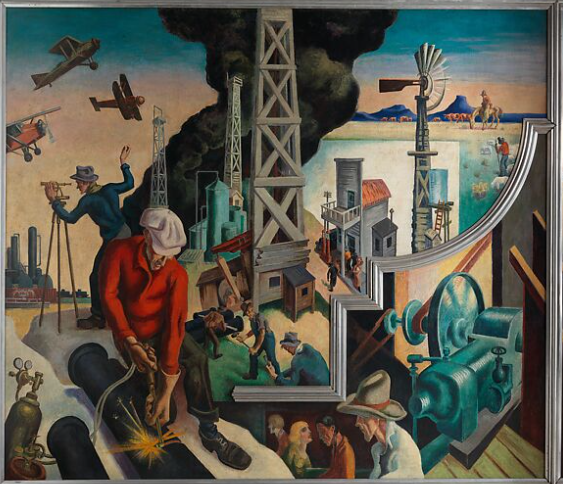
West
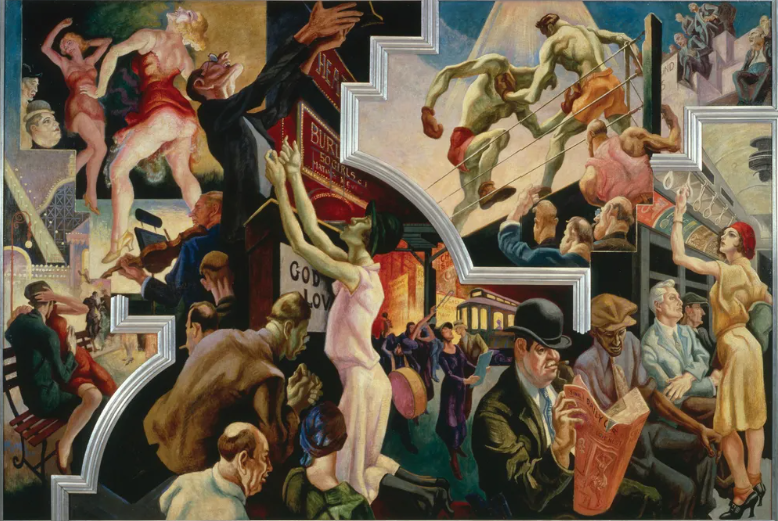
City Activities with Subway 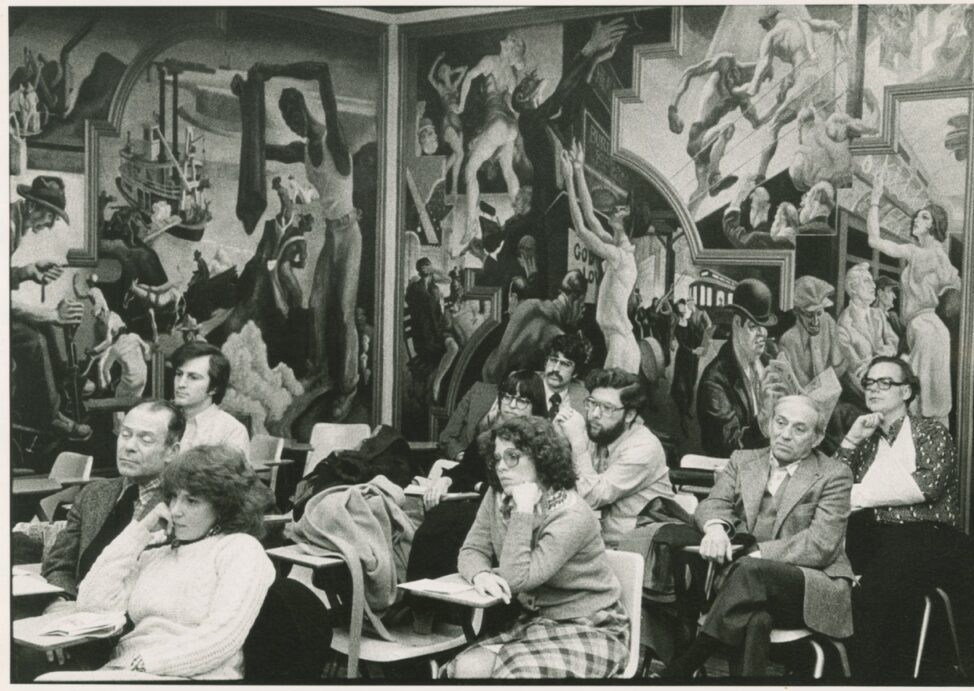
The boardroom later became a classroom
Right: Courtesy of New School Archives & Special Collections, The New School, NY NY.
The smallest panel (shown above, as the header image), called Outreaching Hands, shows frantic hands reaching for bread and a cup of coffee while other hands clutch money … allusions to the economic despair and social disparity caused by the Great Depression, which began in 1929.
Fifty years after its unveiling, the New School realized that perpetual restoration and conservation efforts would be too costly so the mural was sold to Equitable Life (now AXA) in 1984. They in turn donated the 10 panels to the Metropolitan Museum of Art in 2012, where they were on view for some time in a specially designed arrangement replicating the original board room. Regrettably, America Today is no longer on display at the Met, despite being considered one of the most significant accomplishments in American art of the interwar years.
The New School mural — which portrayed America at work — was followed by The Arts of Life in America (1932), which showed America at play. The five-part series was commissioned for the newly-founded Whitney Museum of American Art in New York City.
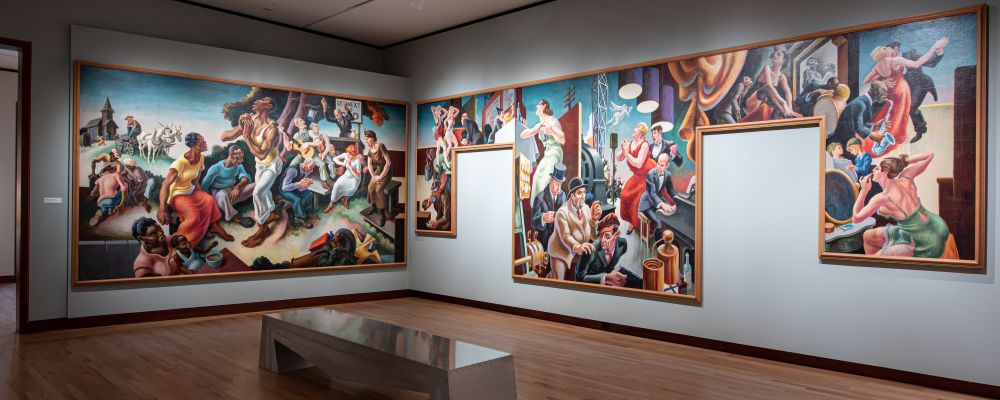
This is what Benton had to say about the subject of the project: “The Arts of Life are the popular arts and are generally undisciplined. They run into pure unreflective play. People indulge in personal display; they drink, sing, dance, pitch horse shoes, get religion and even set up opinions as the spirit moves them. […] They are undisciplined, uncritical and generally deficient in technical means, but they are Arts just the same.”
Benton was an accomplished musician and he imbued the scenes with his love of music. Men and women—young and old, white and black, rich and poor—are shown playing instruments, singing and dancing with abandon. In the four murals and single lunette, he depicted the local art forms and entertainments of the South, the Cities, and the West, as well as Native Americans.
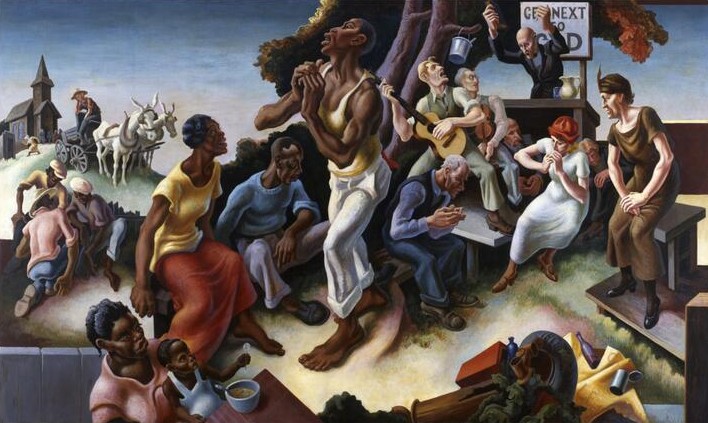
Arts of the South 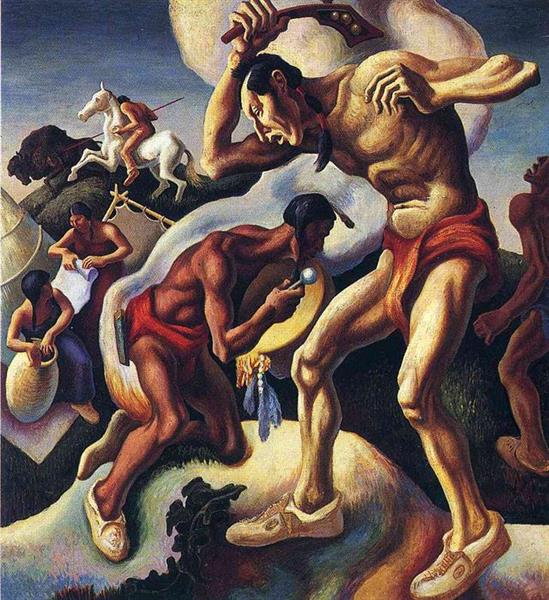
Indian Arts 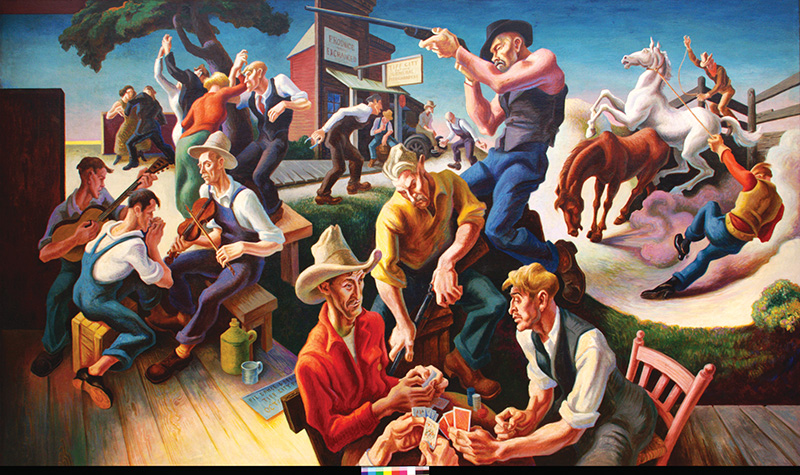
Arts of the West
However, by the 1950s — a mere two decades later — representational and narrative art was considered so outdated that the Whitney sold the panels to the New Britain Museum of American Art in New Britain CT. When word got out that the five panels had been sold for a mere $100 each, the art world referred to it as “The Great Benton Art Heist.” The value today of the New Britain Museum mural cycle is in the multiple millions of dollars.
Those first two mural series were New York City commissions. His third large-scale project was commissioned by the State of Indiana for their exhibition at the Chicago World’s Fair. The Century of Progress International Exposition ran for 18 months in 1933-’34 and gave Benton exponentially more exposure.
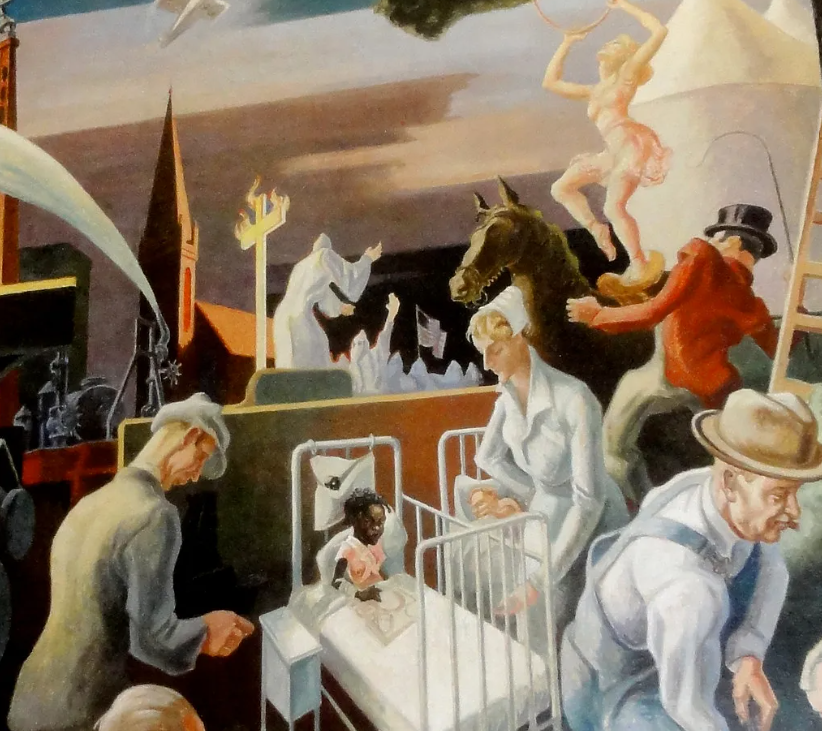
The Social History of the State of Indiana (1933), was an extraordinary 250-foot-long, 26-panel mural cycle that charted Indiana’s history from early pioneers to modern industry and agriculture. It was immediately controversial due to the depiction of hooded members of the Ku Klux Klan in the 1920s. Benton was uncompromising about confronting the realities of history and he refused to remove the offending scene.
Benton’s rejection of racism is well-documented, from his participation in the NAACP-organized 1935 exhibition, An Art Commentary on Lynching, to learning the African-American dialect Gullah. His paintings unfailingly evidence empathy for the black experience in the American story.
A Social History of Indiana, detail (1933) 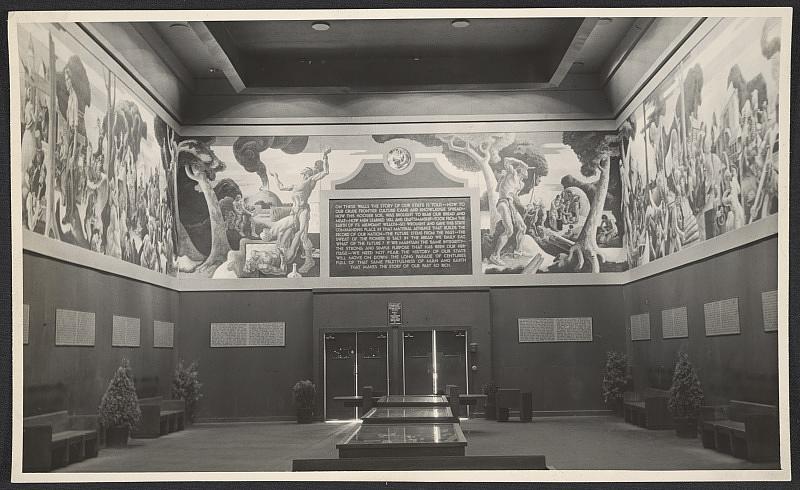
Installation view, Bloomington, Ind.
Interestingly — although the motivating trigger was different — in 2017 controversy again swirled around the mural, which is now displayed at Indiana University, Bloomington. With nearly 1,600 signatories, a student petition called for the offending scene depicting the Klan to be removed. In response, rather than whitewash it, the school stopped holding classes in the room, the largest lecture hall on campus.
In the mural, the Klansmen are seen alongside a reporter, photographer, and printer—a reference to the Pulitzer Prize-winning 1928 article that uncovered the KKK’s ties to the government and broke their political influence over the state.
The 2017 controversy is a perfect example of how important context is for appreciating art, especially narrative art. The less aware one is of the reference story the more likely it is that the essential message of the narrative will be missed — or worse, misunderstood. All it takes is a couple of generations for meaning to be lost.
The ability to understand a work of narrative art tends to wane the further removed you are in time, place, culture from the origin story. Greek mythology and Bible stories, for example, have been represented millions of times throughout the history of art — but if you aren’t familiar with the myths and biblical references the underlying messages about human nature, society, or life are obscure. In which case they are nothing more than “pictures.”
Hot on the heels of the Indiana mural, Benton’s home state commissioned A Social History of the State of Missouri.
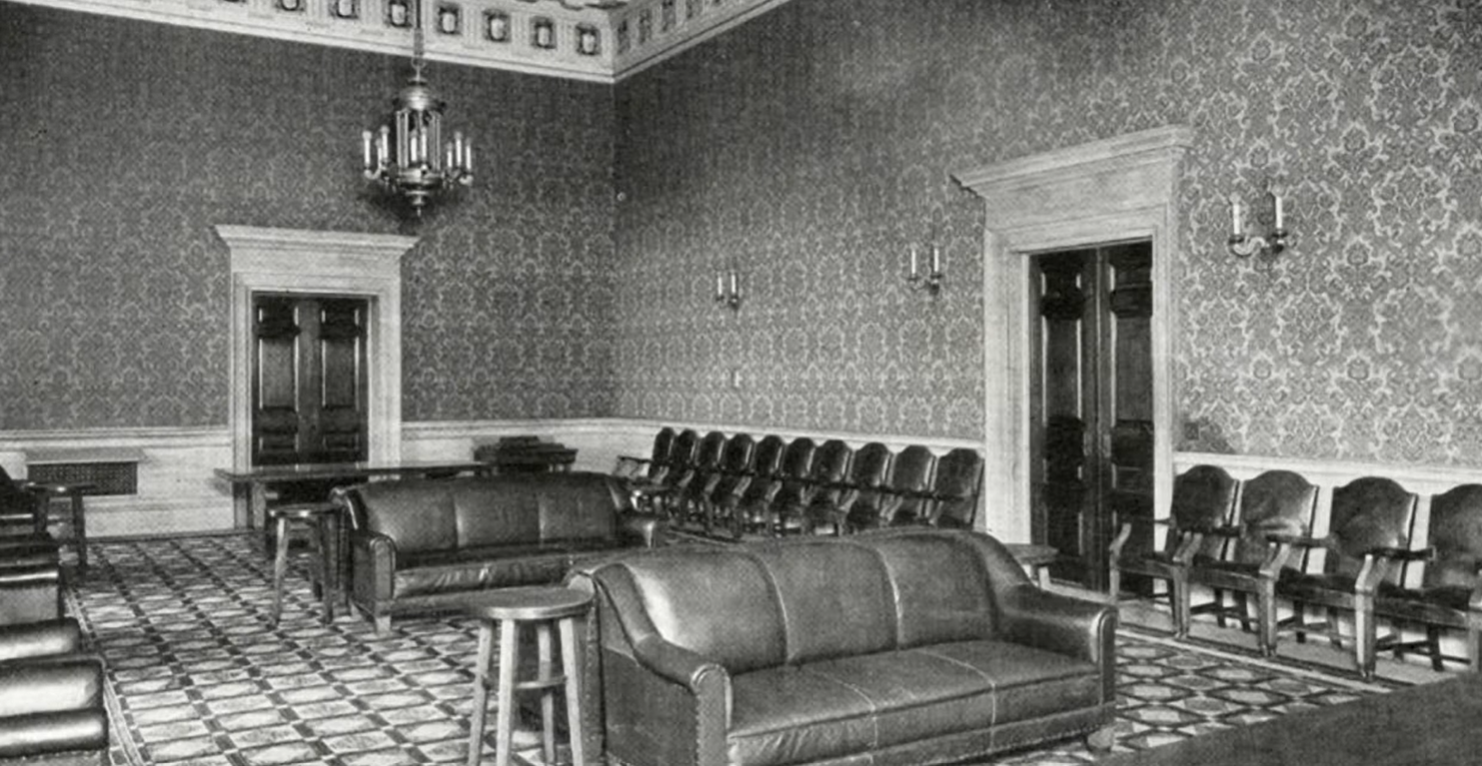
On our recent art pilgrimage to Kansas City and St. Louis, we detoured to the state capital, Jefferson City, to see Benton’s brilliant historical narrative on the walls of the House Lounge in the Capitol Building. Our timing was such that the room was unoccupied and we were shown the way in.
Formerly decorated with a traditional flocked wallpaper, since 1936 the periphery of the room has been teeming with vivid color and bold human activity.
Then 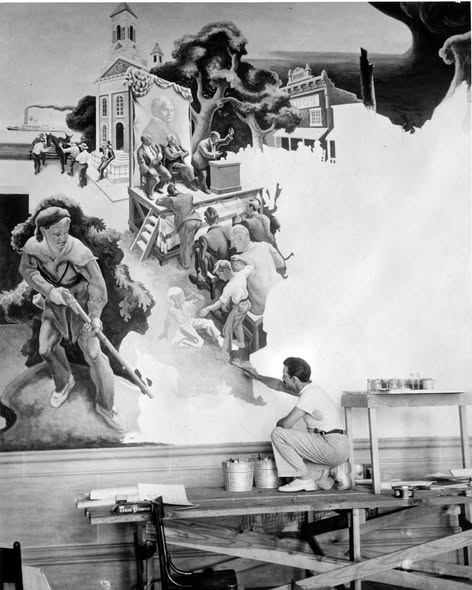
Benton at work. 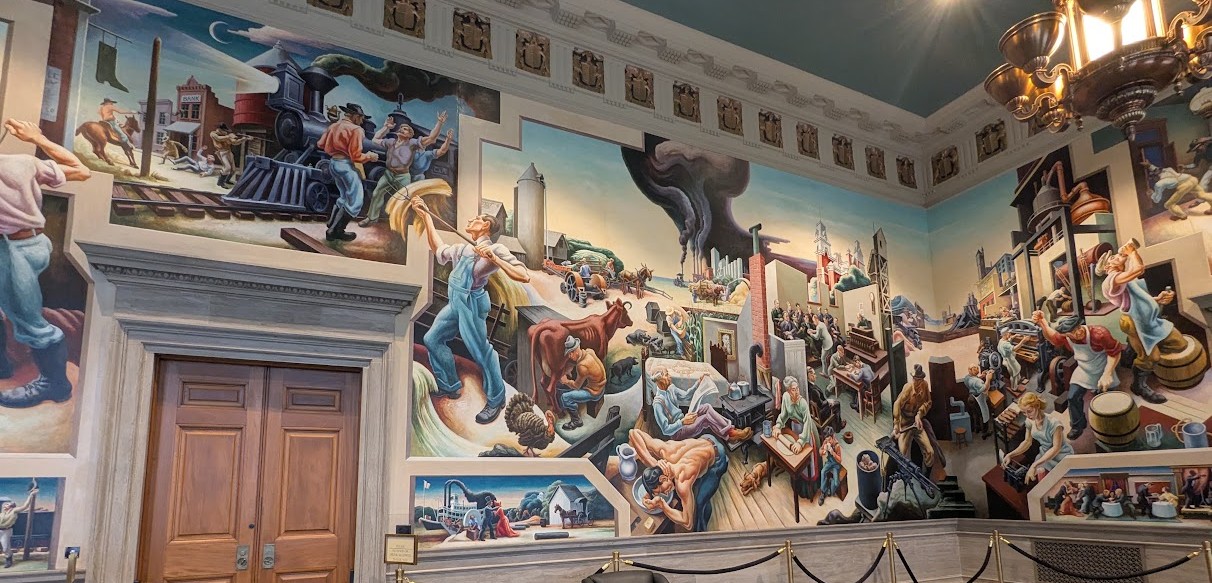
Now
After a minute of awed gazing, though, and feeling a tad overwhelmed, we were reminded again of how essential context is to the full appreciation of narrative art. Our knowledge of the history of the State of Missouri was virtually nil, so without a guide we would have missed the essence — or perhaps misinterpreted — many of the vignettes. We would have been limited to appraising Benton’s technique, use of color and mastery of composition, and being amazed that, after 18 months of preparatory work, Benton painted the entire room in six months — during the hottest summer on record.
Benton’s chronological and thematic excursion through Missouri’s history depicts everyday people, rural and urban life, and industrial growth in St. Louis and Kansas City. Again the chronicle contains numerous raw historical truths —such as the French trading whiskey with Native Americans, slavery, the 1838 expulsion of the Mormons, a Jesse James bank robbery, a well-known corrupt political figure … and a controversial baby’s bare bottom.
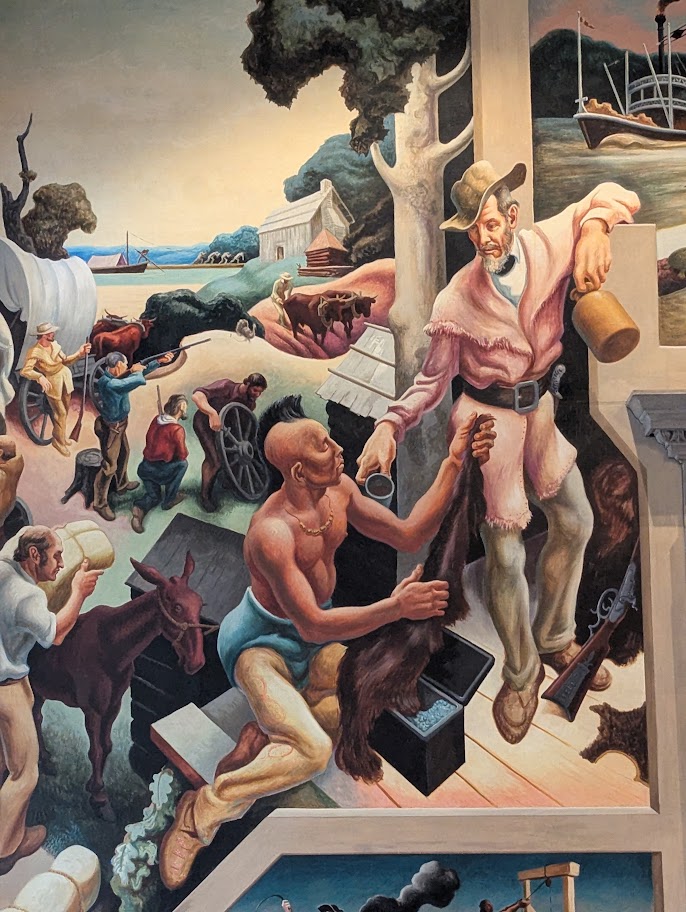
1700s; Osage and French Trader 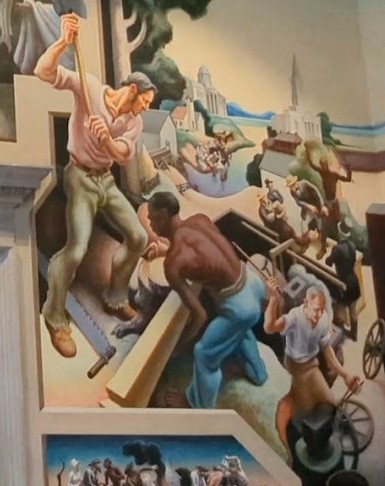
1800s; Statehood in 1821
The story begins in the far right hand corner with a scene from the 1700s, before Missouri became a state, with a French fur trader engaging with a member of the Osage tribe. This figure is the only one of 200 faces on these walls that isn’t modeled after an actual Missouri resident. By the 1930s the Osage had been gone from the area for more than a century, so Benton — a stickler for realism — found a full-blooded Osage in Oklahoma to model for this role.
Moving to the 1800s we see the original and subsequent state capitol buildings, a river baptism, a slave auction, and the lumberjacks and blacksmiths that made up the early labor force.
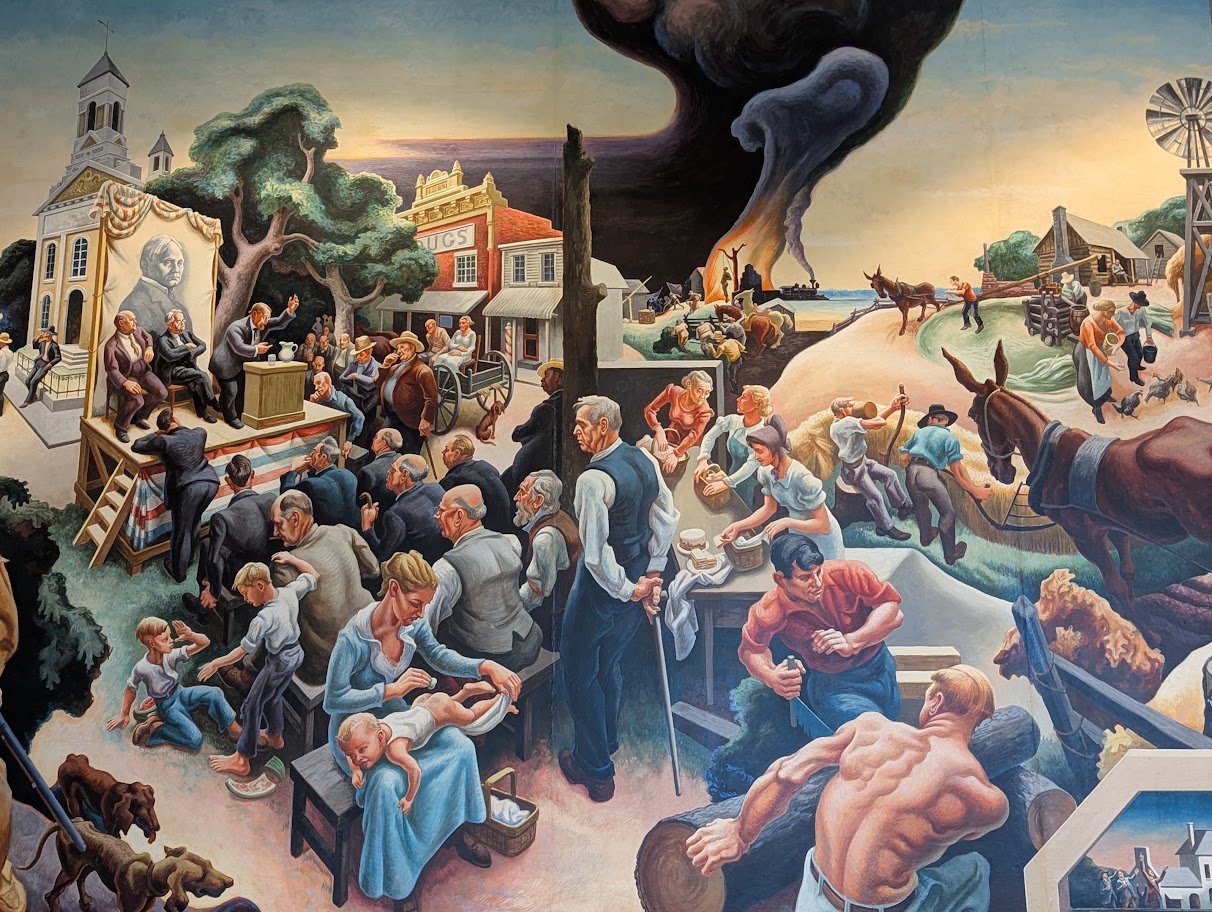
The 1900s open with a political rally, in which Tom Benton’s father, a US Congressman, is at the podium, with Jordan Chambers, known as the “Negro Mayor of St. Louis,” listening, leaning against a tree trunk. In his memoir, Benton said that Guy Park, the former Governor of Missouri — who is sitting on the stage — called him into his office and told him that an important politician from St. Louis objected to the way Benton portrayed black people in his work, especially his graphic images of slavery. He met with the politician who turned out to be Jordan Chambers and explained that he wanted to use the historic depictions to show the progress that African Americans had made in Missouri. Benton won him over and Chambers agreed to model for the mural.
Political Rally 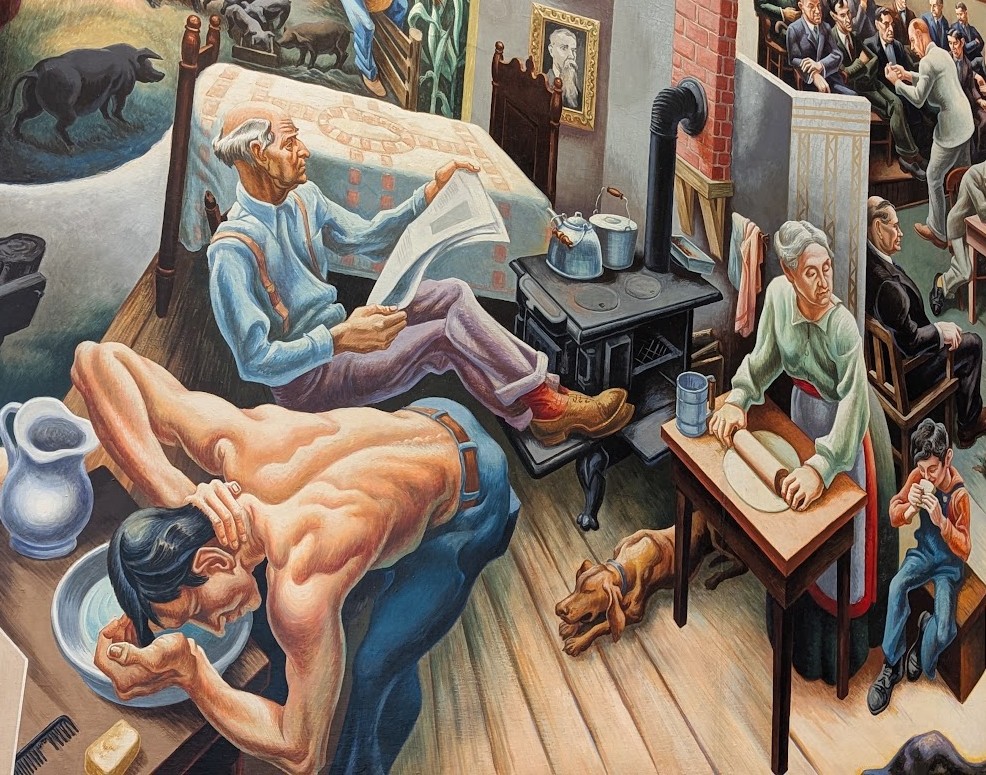
Century Farmstead
The nasty black cloud in the background represents the Civil War, which — given the state’s geography, put Missouri in the middle of the fight between North and South vying for control of the area. We were surprised to learn that the third highest number of Civil War battles were fought in Missouri.
Now, about that bare-bottomed baby… Harold Brown Jr. is enshrined in the state’s history only because his father, who had recently been appointed Missouri’s adjutant general, was being sketched for the mural — as the foreman of the jury in the courtroom scene. Benton noticed the child and asked if he could be included in the painting. Was Benton surprised that the portrayal of a diaper-change created a furor? I wonder.
Missouri agriculture is represented first with mules and later with tractors. In a “century farmstead” — so called because some of these farms would stay in the same family for 100 years or more — we see multiple generations living together in extremely cramped quarters. The adjacent courtroom scene features Benton’s brother, a lawyer, talking to the jury, while the judge struggles to stay awake.
Boss Tom 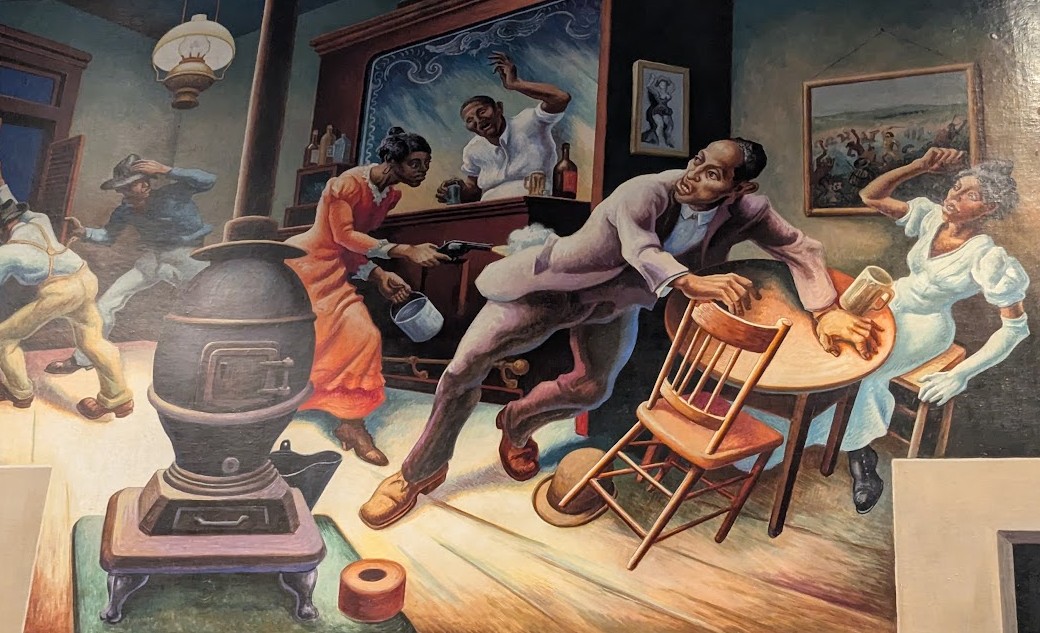
Frankie and Johnny 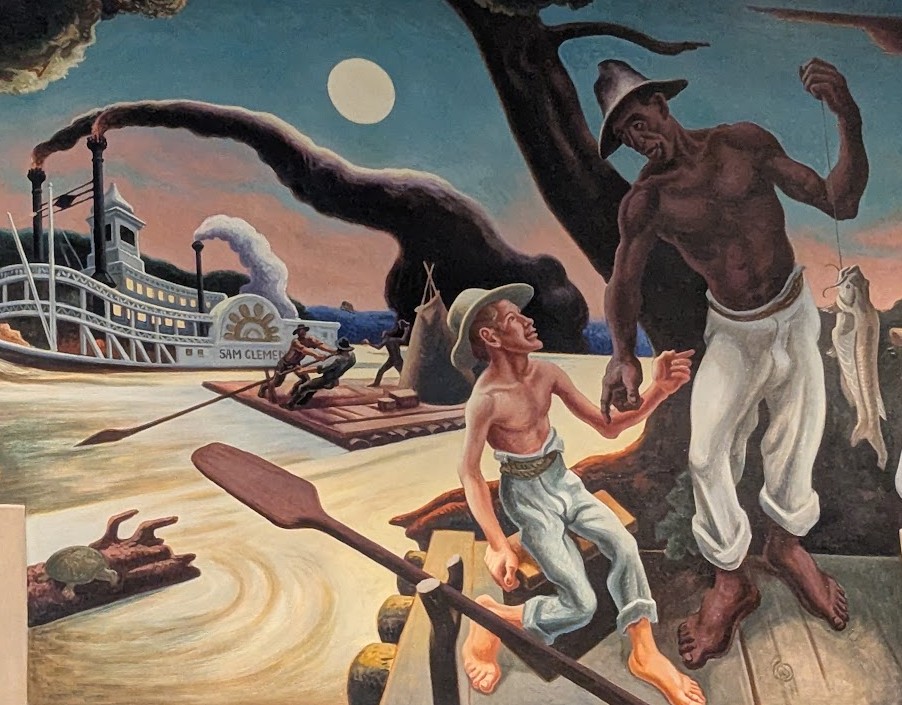
Huckleberry Finn
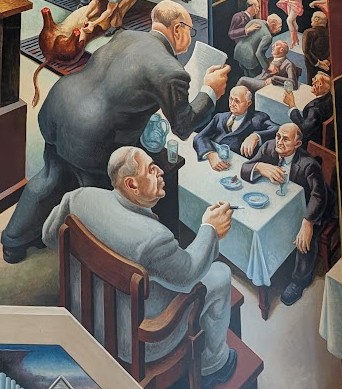
Another big black cloud represents the industrial Revolution. Shoe factories are shown, since St. Louis claimed to be the world’s largest shoe-producing city in the world. Kansas City is represented by it’s meatpacking plants, livestock auctions and pharmaceutical industry. And of course, Kansas City’s renowned corrupt politician, Boss Tom, makes an appearance in the narrative. No one dared make a move in KC in the 1930s without Tom Pendergast’s approval … and his approval usually came at a cost. Two years after the mural was finished, Pendergast was imprisoned for tax fraud. Needless to say, some of the politicians who used the room were unhappy about seeing Boss Tom’s image every day … since they were elected only by the indulgence of his devious machinations.
When it was completed and the Legislature returned for its every-two-years session, then-Speaker of the House John G. Christy objected to the mural, saying that no one would be able to relax in the room because the figures were jumping off of the walls. Christy tried and failed to pass a resolution to have the paintings redone — it had been paid for with $16000 of taxpayer money. Apparently, the day before the legislative session began, Christy and then-Majority Floor Leader Morris Osborn had breakfast at the Madison House Hotel. Christy loudly ranted, “Have you seen those damnable paintings in the House Lounge?”
Uh oh … sitting behind him at the next table was Thomas Hart Benton. At that moment a woman approached the artist to compliment his accomplishment. Benton got up, stood next to Christy and told the woman, “I just heard some comments about art from somebody who knows nothing about it, and if he studied the rest of his life would know even less.” And with that he walked out and didn’t return to Jefferson City for 25 years, when he was asked back to restore his work.
Benton painted other murals over the years — in fact, the night he died in his studio in 1975, he was about to put his signature on six-foot by ten-foot The Sources of Country Music for the Country Music Hall of Fame in Nashville TN.
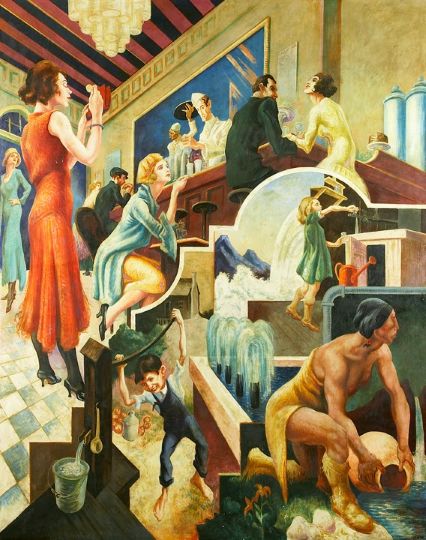
The History of Water, c.1930 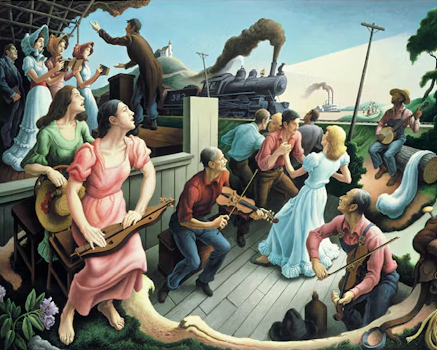
The Sources of Country Music, 1975
Among his earliest, The History of Water was painted as a paid commission for a drugstore on 14th Street in Washington, D.C., to provide Benton with the wherewithal to work on the fee-free America Today mural. Relatively small, measuring roughly 84″ by 65″, the mural disappeared soon after it was executed. The drugstore went out of business and it was removed from the wall and placed in the basement; there it sat forgotten for nearly 50 years. It was rediscovered in 1985, when someone noticed that it was signed “Benton” in black paint at the lower right. After being verified as the long-missing work, it was put up for auction at Sotheby’s and is now in private hands.
But it was the four large narrative cycles that he executed in the 1930s that established him as one of the most widely-known painters in America. He loved the common people and they loved him. He was a visual historian, and through his murals he enlivened the American story in order that its lessons not be forgotten, for generations to come.
Click here to read more about Thomas Hart Benton’s life and art in our article, Have You Met Thomas Hart Benton?
Hmmm … maybe it’s time to plan a little trip …
Missouri State Capitol
201 W Capitol Ave, Jefferson City, MO
573-751-2854
Header image: Thomas Hart Benton, Outreaching Hands panel from the America Today mural
Art Things Considered is an art and travel blog for art geeks, brought to you by ArtGeek.art — the only search engine that makes it easy to discover 1800 art museums, historic houses & artist studios, and sculpture & botanical gardens across the US.
Just go to ArtGeek.art and enter the name of a city or state to see a comprehensive interactive listing of museums in the area. All in one place: descriptions, locations and links.
Use ArtGeek to plan trips and to discover hidden gem museums wherever you are or wherever you go in the US. It’s free, and it’s easy and fun to use!
© Arts Advantage Publishing, 2026